
Posted by Mia Wren on 12th Jul 2026
Best Baking Trays UK: What to Look For and What to Avoid
There's a particular sound a cheap baking tray makes a couple of minutes after it goes into a hot oven: a sharp metallic crack as the base buckles. If you've heard it, you already know what this guide is about. The tray warps, the cookies slide into one corner, and eighteen months later you're standing in a shop buying another one probably from a brand you thought was a step up from the last brand that failed.
Most advice about baking trays is written by people who haven't worn one out. This guide takes the opposite approach. We'll start with why trays fail showing warping, flaking, rusting because once you understand the failure, you know exactly what to look for on the shelf. Then we'll cover materials, sizes that actually fit UK ovens, and the small number of trays we'd suggest most home bakers own.
Why most baking trays fail early
Pick up the last tray you threw away and it almost certainly died one of three deaths.
Death one: warping
That bang from the oven is thermal shock. Metal expands as it heats, and if one part of the tray heats faster than another, the stress has to go somewhere. In a thin tray, it goes into a sudden buckle when the middle pops up or a corner kicks down, often with an audible crack. Sometimes the tray settles flat again as it cools. Do it enough times and the warp becomes permanent.
Thin metal is the culprit. A tray pressed from 0.3mm or 0.4mm steel simply doesn't have the mass to absorb uneven heating, so it flexes instead. Thicker metal, like 0.5mm carbon steel, for instance, heats more evenly in the first place and has the rigidity to hold its shape while it does. This is why the weight of a tray in your hand is the single most honest signal of quality you'll get in a shop. A tray that feels flimsy will bake like it, and a warped tray isn't just noisy: liquids pool at one end, biscuits bake thick on one side and thin on the other, and nothing sits level again.
We've written a full explainer on this — why bakeware warps and what to do about it — but the short version is: buy heavy, and don't shock a hot tray with cold water.
Death two: the coating gives up
The second failure is slower. The non-stick surface works beautifully for a few months, then food starts to grab, then the coating visibly wears or flakes usually starting at the corners or wherever a metal spatula scraped. On budget trays the coating is thin, applied over a primer, and not designed to survive the dishwasher; detergent and heat strip it a little further with every cycle.
There's nothing wrong with non-stick as an idea. The problem is that a coating is only as good as what it's bonded to and how thickly it's applied. A fragile film on thin aluminium fails fast. A quality coating bonded directly to heavy steel with no plastic primer layer underneath wears at a completely different rate. If you want the fuller picture of what separates the two, our guide to what makes quality bakeware goes deeper.
Death three: rust
Rust usually follows death two. Once the coating has worn through, the exposed steel underneath meets water often in the dishwasher, or left to air-dry in a draining rack and and brown spots appear. At that point most people bin the tray, reasonably enough. Rust is rarely a materials failure; it's the end stage of a coating failure plus wet storage. It's also almost entirely preventable: a tray that's hand washed and towel dried can spend a decade rust-free.
What to look for when buying
Knowing the three failure modes, the shopping checklist writes itself.
Weight and gauge
Heavier is better, almost without exception. Thickness of metal (the gauge) determines whether a tray heats evenly and holds flat. You won't find gauge printed on many boxes, so use your hands: a good 33 × 23cm tray should feel substantial (around half a kilogram) and shouldn't flex when you hold it by one end. If it bends in the shop, it will buckle in the oven.
Material
Carbon steel is what we build with, and what most professional bakeware is made from. It's denser than aluminium, so it holds and spreads heat steadily and that's what gets you an evenly golden base rather than a pale middle and burnt edges. Its one weakness is that bare carbon steel rusts, which is why it's either seasoned (like a cast-iron pan) or coated. Coated carbon steel gives you the even bake and the easy release without the maintenance.
Aluminium conducts heat quickly and is light, which is why commercial kitchens use it in stacks. But home-weight aluminium trays are usually thin, and thin aluminium warps readily. Professional bakers get away with it because their trays are thick, flat-stacked, and treated as consumables and therefore replaced without sentiment when they dent. That's a reasonable system for a bakery. It's an expensive habit for a home kitchen.
Stainless steel is durable and has no coating to fail, which sounds ideal. In practice it's a mediocre heat conductor, so thin stainless trays develop hot spots, and food sticks to it enthusiastically so most owners end up lining them with baking parchment for everything. If you're happy baking on parchment forever, stainless lasts. Most bakers aren't.
Enamelled trays look the part, but enamel is glass fused to metal, and glass chips. Metal utensils, a knock against the oven shelf, or a stack of other tins will scratch and chip the surface, and once moisture gets under the enamel, rust follows. Owners regularly report enamel trays scratched within weeks.
Glass and ceramic hold heat well but respond slowly, which makes them fine for casseroles and crumbles and poor for anything that needs a crisp base or a fast, even bake. Keep them for the Sunday crumble; don't roast chips on them.
The coating
Look for a coating bonded directly to the metal rather than layered over a primer, and check what it's made from. All Wrenbury flat trays use a DuraQuartz non-stick surface made without PTFE or PFOA, bonded straight to the steel. The textured versions add a slight grain to the surface, which reduces the contact area under your bake — that's why cookies slide off rather than needing to be prised.
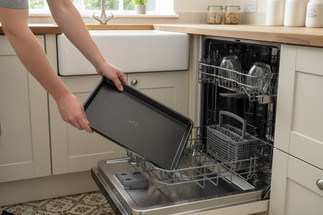
Whatever you buy, treat "dishwasher safe" as "dishwasher tolerant". Every manufacturer honest enough to say so — us included — will tell you hand washing keeps any coating in better condition for longer.
Size that fits a UK oven
A standard UK built-in oven is 60cm wide outside, which leaves an internal cavity around 45–48cm wide. For even baking you also want 2–3cm of air moving around the tray, so the practical ceiling for tray length is about 40cm.
That gives you two genuinely useful sizes. A quarter-sheet tray around 33 × 23cm fits any standard oven with airflow to spare, and it's the size you'll reach for most days — cookies, roasted vegetables, a small traybake. A larger tray around 39 × 27cm is the biggest that sits comfortably in most UK ovens, and it earns its keep for Swiss rolls, focaccia, and family-sized traybakes. Measure your oven's internal shelf before buying anything bigger; plenty of imported "half-sheet" pans are sized for American ovens and won't fit.
The guarantee
A guarantee tells you what the maker expects to happen. A tray guaranteed for a year is expected to fail shortly after one. Every Wrenbury tray carries a 10-year guarantee covering warping, coating defects, peeling and flaking in normal use — which is less a marketing flourish than a statement about steel thickness. You can't guarantee thin metal for a decade, because it won't last one.
The trays worth owning
We'd rather you owned three good trays than a cupboard of failing ones. Here's the short list.

Cookie Sheet Pan Baking Tray — 32cm x 22cm
£16.99
The everyday tray — quarter-sheet size that fits any UK oven, in flat heavy carbon steel with a textured non-stick surface.
View product
Swiss Roll Tin Baking Tray — 39cm x 27cm
£22.99
The big flat tray — Swiss rolls, focaccia and family traybakes, in heavy-gauge carbon steel that stays flat in a hot oven.
View product
Batch Baking Bundle — 2 Mini Muffin Trays + 2 Small Baking Trays
£39.99
A complete batch-baking setup in heavy-gauge carbon steel — and a proper starter set for a new kitchen.
View productThe everyday tray: the quarter sheet
The Cookie Sheet Pan is the tray you'll use five days out of seven. At roughly 33 × 23cm it fits every standard oven with air to spare, the pro-thickness steel gives cookies and traybakes an even, golden base, and the textured surface releases without a fight. If you only replace one tray after reading this, replace it with this one.
The big flat tray: the Swiss roll tin
Don't let the name pigeonhole the Swiss Roll Tin. Yes, the shallow 39 × 27cm shape is exactly right for a sponge that rolls without cracking — the even edge-to-centre browning keeps the sponge flexible, and if roulades are your thing our Swiss roll troubleshooting guide is worth ten minutes. But this is also the roasting and focaccia tray: the largest flat surface that fits comfortably in a UK oven. Batch bakers can take the set of two Swiss roll tins and run both shelves at once.
The clean-slate option: the Batch Baking Bundle
If you're starting from scratch — first kitchen, or a clear-out of everything that's warped — the Batch Baking Bundle solves it in one box. Two small baking trays for everyday cookies and roasting, plus two 24-cup mini muffin trays for egg bites, canapés and freezer batches. .
How many trays do you actually need?
For most home bakers: two flat trays and whatever speciality tins your baking demands. Two flat trays because ovens have two shelves and biscuits are always baked in batches — one tray loads while the other bakes. A quarter sheet and a Swiss roll tin cover between them almost everything flat: cookies, traybakes, focaccia, roast vegetables, reheating, and the underrated job of sitting beneath a pie dish to catch drips.
Everything beyond that is about what you bake, not what a list tells you. The rest of the range — loaf tins, Yorkshire pudding tins, muffin trays — lives in the full bakeware collection when you're ready.
Make it last: the sixty-second version
A good tray fails early only if it's helped. Three habits do most of the damage: running a hot tray under the cold tap (that's the thermal shock that warps even decent metal), leaving it to soak overnight (water is the enemy of any steel), and cupboard-stacking it wet. Wash by hand in warm soapy water, dry it with a tea towel straight away, and it will outlast the guarantee. The full routine is in our care and use guide, and if you want the long version, how to make your baking tray last 10 years is exactly what it says.
One thing you don't need to do: season a coated tray. Coated carbon steel is ready to bake with out of the box — oiling and baking it "to season it" just builds a gummy film. We've covered when a new tin needs seasoning and when it doesn't separately.
Common questions
Why do baking trays warp and bang in the oven?
The bang is thermal shock: one part of the tray heats faster than the rest, the metal expands unevenly, and a thin tray buckles under the stress. Thicker metal heats more evenly and holds its shape — a 0.5mm carbon steel tray has the mass to absorb the stress that folds a 0.3mm one. Avoid putting frozen food on a hot tray or running a hot tray under cold water, both of which force the same sudden shock.
Why do non-stick trays start sticking after a few months?
Because the coating is wearing away — usually thinned by dishwasher cycles, scratched by metal utensils, or simply applied too thinly in the first place. A coating bonded directly to heavy steel wears far more slowly than a thin film over a primer on budget aluminium. Once a coating has visibly flaked, retire the tray; the exposed steel underneath will rust.
Can I put a baking tray in the dishwasher?
Wrenbury trays are dishwasher safe, and one cycle won't hurt. But every trip through the dishwasher costs any non-stick coating a little of its life — the detergent is designed to strip baked-on grease and doesn't distinguish. Hand washing in warm soapy water takes under a minute and keeps the surface in far better shape for far longer.
What size baking tray fits a standard UK oven?
A standard 60cm UK oven has an internal width of roughly 45–48cm, and you want 2–3cm of airflow around the tray. In practice that makes 39 × 27cm the sensible maximum for most ovens, and a 33 × 23cm quarter sheet the safe everyday size. Measure your oven shelf before buying anything larger — many imported half-sheet pans are made for wider American ovens.
Professional kitchens use aluminium trays — shouldn't I?
Commercial aluminium works in commercial conditions: thick sheets, flat storage in tall stacks, and a budget line that quietly replaces them when they dent or warp. At home, the aluminium trays you'll find are thinner, stored on their edges in a crowded cupboard, and expected to last years rather than months. Heavy carbon steel suits home baking better: it bakes more evenly at domestic gauges and doesn't need replacing on a rota.
What is the non-stick coating on Wrenbury trays made from?
Our flat baking trays use a DuraQuartz non-stick surface bonded directly to the carbon steel, made without PTFE or PFOA — there's no plastic primer layer between coating and metal, which is a large part of why it resists wear. We've written a plain-English guide to what PTFE-free bakeware actually means if you want the detail.
The short answer
Buy heavy, buy the right two sizes, and stop buying trays on a subscription you never signed up for. A 33 × 23cm quarter sheet for every day, a 39 × 27cm tray for everything bigger, both in heavy-gauge carbon steel with a coating made without PTFE or PFOA — and a guarantee long enough to mean something. The tray should be the most boring thing in your kitchen: flat, quiet, and still there in ten years.