
Posted by Mia Wren on 2nd Jul 2026
Best Muffin Tin UK: How to Choose the Right One
You greased it. You bought the one labelled non-stick. And you still ended up prising muffins out with a knife while the tops tore off at the rim. If that sounds familiar, the problem probably isn't your recipe, it's the tin.
Muffin tins look interchangeable on a shelf. They aren't. The difference between a tray that releases twelve clean muffins for a decade and one that sticks, warps and starts shedding its coating within a year comes down to a handful of things you can check before you buy.
This guide covers what actually matters: material, coating, cup size and build plus the tins we'd recommend and answers to the questions bakers ask most.
Why cheap muffin tins let you down
Most muffin tin complaints fall into three camps, and all three trace back to how the tin is made.
Sticking. "Non-stick" on the label tells you almost nothing about how a coating performs after six months of use. Thin coatings on lightweight trays wear through quickly — especially around the top edge of each cup, where muffin tops spread and bake onto bare metal. That's why muffins so often release at the base but tear at the rim. A decent coating on a properly prepared surface keeps releasing cleanly for years, not weeks — we've written more about what separates a quality non-stick coating from a cheap one.
Warping. If you've ever heard a loud pop from the oven, that was your tray buckling. Metal expands as it heats, and a thin tray expands unevenly — the flat face heats faster than the edges, the stress builds, and the tray twists to relieve it. Once a muffin tray warps, it never sits flat again: batter settles unevenly, some muffins bake faster than others, and it rocks on the oven shelf. Thin trays warp because there isn't enough metal in them to hold their shape — the full physics is in our guide to why bakeware warps and what to do about it. Heavy-gauge carbon steel doesn't have that problem: there's more steel resisting the stress, so the tray heats evenly and stays put.
Flaking. The most common reason bakers throw a tin away isn't sticking — it's spotting flecks of coating in the bottom of a muffin. Coatings flake when they're applied thinly to metal that flexes. Every warp and every wash stresses the bond a little more until it lets go. A rigid tray with a properly bonded coating avoids the flexing that causes it.
If a tin is cheap enough to replace every year, that's usually exactly what you'll end up doing. Three replacement trays cost more than one good one — and the good one is still going a decade later.
What to look for in a muffin tin
Material and gauge
Carbon steel is the material to look for. It heats evenly, holds its shape at high temperatures, and takes a non-stick coating well. The key word is heavy-gauge — the thickness of the steel is what stops the tray twisting in a hot oven. Pick a tray up before you buy if you can. If it feels light enough to flex between your hands, it'll flex in the oven too.
Thin aluminium trays are the ones that buckle. Silicone moulds solve the warping problem by not being rigid at all, but they trade it for a worse one: silicone conducts heat poorly, so muffins bake pale, rise less, and the wobble makes transferring a full tray of batter to the oven genuinely stressful.
The coating — and what should be in it
A good non-stick coating should release muffins with a twist and a tap, and it should do so without PTFE or PFOA. Wrenbury coatings are made without either — there's nothing in the coating designed to flake off into your food, and nothing that needs babying below a certain temperature.
Whatever tin you buy, check what the coating is made without. If the listing won't tell you, that's an answer in itself.
Cup colour and browning
Darker tins absorb heat faster than pale ones, which means more colour on the base and sides of your muffins. That's usually what you want — a golden crust with a proper dome. If your current pale tin gives you anaemic-looking muffins that taste fine, the tin's the reason. Knock the oven down 10°C if you're switching from a pale tray to a dark one and your recipe was written for the former.
Build details worth checking
A rolled or reinforced rim stiffens the whole tray and gives you something to grip with oven gloves. Generous spacing between cups lets air circulate so the sides bake evenly. And a tray should sit dead flat on a work surface — check when it arrives, and check again after the first few bakes. A flat tray that stays flat is the single best sign you've bought well.
Measure your oven before you buy, too. A standard 12-cup tray is around 35 × 29cm, which fits any UK oven with room to spare — but if you're planning to run two trays side by side on one shelf for batch baking, check your oven's internal width first. Two trays stacked on separate shelves work fine as long as you swap them halfway through the bake; the lower tray always browns faster underneath.
Cup depth matters more than most listings admit. Shallow cups give you flat, spread-out muffins however good your batter is. Look for cups deep enough that two-thirds full still leaves headroom — that's where the dome comes from.
Which size do you need?
Muffin recipes are nearly all written for a standard 12-cup tin, so start there unless you have a reason not to.
Standard 12-cup — around 100–120ml per cup. The workhorse. Handles muffins, cupcakes, breakfast egg bites, Yorkshire puddings at a pinch. If you own one muffin tin, it's this.
24-cup mini — around 30ml per cup, a quarter of a standard cup. For canapés, lunchbox-sized bakes, and portion control that doesn't feel like it. Standard recipes work in a mini tray — one batch stretches further, and baking time drops to around 10–14 minutes, so start checking early.
6-cup jumbo — coffee-shop-sized muffins with proper domed tops. A standard 12-muffin recipe fills about six jumbo cups; add 5–10 minutes to the bake and test with a skewer. The deep cups earn their keep beyond muffins, too — they're the trick behind bakery-style cinnamon rolls.
Batch bakers — anyone doing school fairs, freezer stocking or a household that inhales muffins — should go straight to a set of two trays. One batch of batter, one oven, no waiting for the first tray to cool before you can refill it. Both the mini muffin tray and the jumbo pan come as sets of two for exactly this reason.
Our picks
Every tin below is heavy-gauge carbon steel, made without PTFE or PFOA, and covered by Wrenbury's 10-year warranty — which is less a marketing line than a statement of how long we expect them to last.
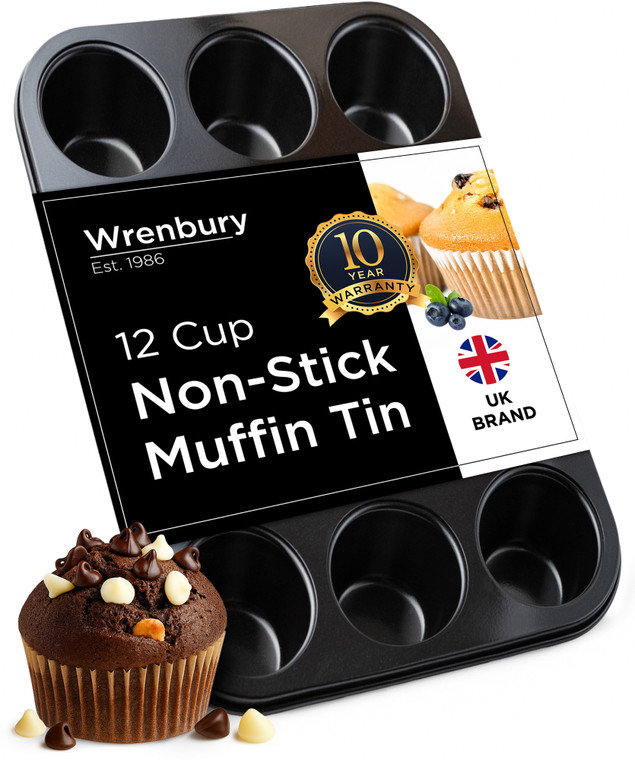
Non-Stick 12 Cup Muffin Tray
£21.99
The standard-size workhorse — releases cleanly and sits flat, bake after bake.
View product
Non-Stick 24 Cup Mini Muffin Tray
£16.99
Twenty-four bite-sized bakes from one batch of standard batter.
View product
Non-Stick 6 Cup Large Jumbo Muffin Pan
£21.99
Deep cups that give you the domed, coffee-shop muffin at home.
View productBatch Baking Bundle
£39.99
Two mini muffin trays and two baking trays: a small production line in one box.
View productBrowse the full range on our muffin and cupcake tins page.
Common questions
Why do my muffins stick even though the tin says non-stick?
Usually one of three things. The coating has worn — common on cheap trays after a few months. The muffin tops spread over the cup edges and baked onto the flat of the tray, which no coating fully prevents (fill cups about two-thirds full to avoid it). Or the muffins were left to cool in the tin too long — steam condenses and glues them in place. Five minutes in the tin, then out onto a rack.
Why did my old muffin tray warp — and is it ruined?
Thin metal expands unevenly in a hot oven and buckles under the stress, sometimes with an alarming bang. Once warped, a tray never bakes evenly again — cups sit at angles and batter runs to one side. There's no fixing it worth the effort. Replace it with something heavy enough not to repeat the trick.
Do I still need to grease a non-stick muffin tin?
For the first few bakes, no — a good coating releases on its own. A light wipe of butter or oil now and then does no harm and helps browning at the edges. What you shouldn't need is the full grease-and-flour routine; if a tin demands that to release a basic muffin, the coating isn't doing its job.
Can I use paper cases in a non-stick tin?
Of course — cases are about presentation and washing-up, not necessity. Worth knowing: muffins stick to paper cases more than they stick to a good coated tin, especially when warm. If your muffins keep leaving half themselves behind on the paper, try baking straight in the tin.
Can I use a standard muffin recipe in a mini muffin tray?
Yes, no conversion needed — the batter doesn't care what shape it goes into. A recipe for 12 standard muffins makes roughly 24 minis. Fill each cup two-thirds full and start checking at 10 minutes rather than the 20–25 a standard bake takes.
How do I clean a muffin tin without wrecking the coating?
Warm soapy water and a non-scratch sponge, nothing more. Skip the dishwasher — hot cycles and harsh detergent shorten a coating's life on any tin. For baked-on muffin-top residue, soak for ten minutes first. Dry thoroughly before it goes back in the cupboard. Full details in our care and use guide — and if you want the long version, how to make your baking tray last 10 years.
Look after it and it's the last one you'll buy
A good muffin tin is one of the cheapest pieces of bakeware to buy well and one of the most annoying to buy badly. Heavy-gauge carbon steel, a coating made without PTFE or PFOA, the right cup size for how you bake — that's the whole checklist. Get those right and the tin outlasts the recipe book.
Our full collection of muffin and cupcake tins is covered by the same 10-year warranty as everything else we make. If yours warps, flakes or gives up inside a decade, we'll replace it. We're not expecting to.