
Posted by Mia Wren on 14th Jul 2026
Roasted Strawberry Mini Cheesecakes: An Independent Baker Puts Our Cheesecake Tin to the Test
In June, Ella of Ella's Better Bakes got in touch and asked whether we would send her our 12-cup mini cheesecake tin to test. The arrangement was simple: we send the tin, she gives an honest review, good or bad, and she publishes what she finds. We said yes, and she baked a batch of roasted strawberry mini cheesecakes with it.
Her full recipe and review are over on her blog: Roasted Strawberry Mini Cheesecakes. This post covers what she made, what she found, and, since we know why the tin is built the way it is, why it behaves the way she describes.
What she made
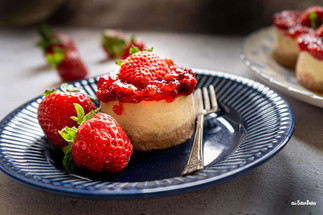
Twelve baked mini cheesecakes: a digestive biscuit base pressed firmly into each cup, a slow-baked vanilla filling, and a topping of roasted strawberries. Roasting the strawberries is the clever part. Twenty-five minutes in a hot oven drives off water and intensifies the fruit, so the topping turns jammy and sits on top of each cheesecake rather than sliding down the sides. It is also a sensible way to use up strawberries that are just past their best, which in July is a real consideration.
She bakes hers low and slow, then leaves them in the switched-off oven for two hours so the temperature falls gently. The shock of moving from a warm oven to a cold counter is what cracks a cheesecake. If you would rather not bake at all, her post includes a no-bake version using mascarpone and double cream.
What she found
Ella reviews bakeware with her own money on the line. Her readers bake her recipes with the kit she recommends, so she has no reason to be kind. Her verdict on the tin:
"The tin is excellent on every level."
On the build: "I was genuinely impressed by the sheer weight of the 12-cup cheesecake tray." On the bake and release: "The strawberry cheesecakes came out deep and evenly baked. They did not stick to the tin, and the loose bottoms in the tin meant they were easy to release." And her closing advice to her readers: "If you are going to make this recipe, invest in a Wrenbury 12 cup cheesecake tin; you won't regret it."
Buy once, buy well. Her words, and a fair summary of what we are trying to do.
Why the tin does what she describes
None of what Ella noticed is accidental.
The weight comes from 1mm commercial-grade carbon steel, roughly twice the gauge of a thin supermarket tin. Heavier steel holds and spreads heat evenly across all twelve cups, which is why her cheesecakes came out "deep and evenly baked" rather than set at the edges and wet in the middle. It is also why the tin will not warp or flex in a hot oven.
The easy release is the loose bases. Each of the twelve cups has its own removable disc. Once the cheesecakes have set, you press up from underneath and each one lifts out whole. No digging with a knife, no torn edges, no biscuit base left welded to the tin. Baked cheesecake is about the most fragile thing you can ask a tin to let go of, which is exactly why we built it this way.
The non-stick coating is made without PTFE or PFOA (the same coating approach we use across the range), so nothing sticks even without liners. A light grease helps, but Ella admits she greases hers purely from habit.
The short version: 12 cups, each 7.5cm across and 5cm deep, 1mm carbon steel, oven safe to 230°C, dishwasher safe (hand washing keeps the coating in better shape), and covered by our 10-year guarantee.

Professional Mini Cheesecake Pan — 12 Cup Loose Base Non-Stick
£34.99
Twelve push-up loose bases, 1mm commercial-grade steel, and a 10-year guarantee.
View productThree of her tips worth stealing
The recipe post is full of proper technique. These three are the ones that make the difference between a good mini cheesecake and a cracked one.
Ella's rules for mini cheesecakes that hold together
- Press the base down hard: the biscuit base only sets firm if it is tightly compacted before chilling. The back of a cup measure or the base of a glass does the job.
- Do not overbeat the filling: too much air makes the cheesecakes rise like soufflés in the oven, then collapse and crack as they cool. Beat each addition briefly, no more.
- Cool them in the switched-off oven: leave the baked cheesecakes in the oven for two hours after turning it off. A gentle fall in temperature is what stops cracking and sinking.
For the full method, the quantities, and the roasted strawberry topping (including the gelatine trick that keeps it sitting neatly on top), head to her recipe.
Frequently asked questions
Do I need to grease or line the cups?
Not strictly. The coating releases without liners, and Ella notes she greases hers from habit rather than necessity. A light grease does no harm, and for chilled no-bake cheesecakes a small disc of parchment on each loose base gives the cleanest possible lift.
Can I make mini cheesecakes in a muffin tin instead?
You can, but you will need paper liners and the release is never as clean. Cheesecake clings to paper, and a muffin tin has no way to push from underneath. The loose bases are the difference: they let you release a fragile baked cheesecake whole, without a knife.
Do I have to bake them, or is there a no-bake version?
Both work in this tin. Ella's post includes a no-bake filling of cream cheese, mascarpone, and whipped double cream that sets in the fridge overnight. She slightly prefers the texture of the baked version; the no-bake one is quicker and needs no oven at all.
Is the coating made without PTFE?
Yes. The cheesecake tin's non-stick coating is made without PTFE or PFOA. If you want the detail on what those terms actually mean, we have written a full guide to PTFE-free bakeware.
What else can the tin make?
Anything individual and fragile benefits from the push-up bases: mini quiches, pork pies, millionaire's shortbread, deep muffins, and savoury egg bites. The cups are 7.5cm across and 5cm deep, so portions come out generous rather than dainty. For more small-format ideas, see our guide to elegant little desserts.
Related reading
The cheesecake tin lives in our cheesecake tins collection. If you are new to carbon steel, how to make your baking tray last 10 years covers the small habits that keep a tin in shape for the length of its guarantee, and the care and use guide has the short version. And if a food blogger's word carries more weight than ours (fair enough), Ella's full review and recipe are here.