
Posted by Mia Wren on 3rd Jul 2026
PTFE-Free Bakeware: What It Means and Why It Matters
Every piece of bakeware I've looked at recently seems to carry the label "PFOA-free." It's printed on the box, listed in the bullet points, sometimes mentioned twice. And that's fine — but it's also created a bit of confusion, because "PFOA-free" is not the same thing as "PTFE-free." Most people don't know the difference, and I can't really blame them. The labelling is deliberately vague.
This post is a plain-English explanation of what PTFE is, why some bakers look for PTFE-free bakeware, and what PTFE-free actually means in practice — including how a tin can still be non-stick without it.
What is PTFE?
PTFE stands for polytetrafluoroethylene. It's the polymer that makes up traditional non-stick coatings — including the one sold under the trade name Teflon. You'll rarely see the word "PTFE" on a tin of bakeware, even if the coating contains it. You're more likely to see "non-stick" and nothing more.
PTFE has genuinely good properties as a coating material. It's extremely slippery, chemically inert, and handles heat reasonably well. For decades, it was the default material for non-stick kitchenware, and it's still used in a lot of products sold today.
The issue isn't that PTFE is inherently dangerous at normal cooking temperatures. It's that at higher temperatures — above roughly 260°C (500°F) — PTFE coatings begin to break down and can release fumes. Domestic ovens regularly run at 220–230°C, and some high-heat baking (Yorkshire puddings, bread at a hot blast to start) goes higher. The degradation accelerates the hotter a coated tin gets, and empty pans left in very hot ovens can reach temperatures that push beyond that threshold quickly.
Why some bakers look for PTFE-free bakeware
The concern falls into three main areas.
Temperature degradation. At temperatures above 260°C, PTFE starts to break down. The products of that breakdown are the thing people are cautious about, not the PTFE itself at ambient temperatures. If you regularly bake at high heat, or if your oven runs hot, that margin matters.
Pet birds. This is probably the most well-documented practical concern. PTFE fumes are acutely toxic to birds — even a single incident of overheating a coated pan in a kitchen with a pet bird nearby can be fatal. This isn't an urban myth; it's a known risk that avian vets routinely advise about. If you have a parrot, budgerigar, or any other pet bird, PTFE-free kitchenware isn't optional — it's essential.
Coating wear over time. When a non-stick coating chips or scratches, there's a question about what happens to those particles. With PTFE-based coatings, a small amount of material may end up in food. The particles are considered inert and are thought to pass through the body without being absorbed — but "inert particles in my food" is understandably something people would rather avoid.
None of this means PTFE bakeware is immediately dangerous to every home baker. But it does explain why people specifically search for PTFE-free alternatives.
PTFE-free is not the same as PFOA-free — and this matters
Here's where the confusion is. PFOA (perfluorooctanoic acid) and PTFE are two different chemicals.
PTFE is the actual coating — the non-stick layer you cook on.
PFOA was a processing aid used to manufacture and apply PTFE coatings. It helped the coating bond smoothly to metal. PFOA was phased out by major manufacturers around 2013–2015 after research linked it to health concerns. It's now effectively banned from cookware production in most markets.
When a product says "PFOA-free," that tells you the manufacturing process didn't use PFOA. But the tin can still contain PTFE — and most do. PFOA-free became the baseline standard for non-stick bakeware several years ago, but it doesn't say anything about whether PTFE is present in the final coating.
If you see "PFOA-free" and assume that means the bakeware is free of fluoropolymers generally, that assumption is likely wrong. To be specific, you need to see "PTFE-free" stated explicitly.
This matters because a lot of marketing around "clean" and "safe" bakeware leans heavily on the PFOA-free label while quietly still using PTFE. The two phrases are not interchangeable, and treating them as synonymous is how a lot of people end up with bakeware they thought was one thing when it's actually another.
If there's no PTFE, how does the tin stay non-stick?
This is the question I get most often, and it's a fair one. PTFE has been the dominant non-stick coating chemistry for so long that it can feel like "non-stick" and "PTFE" mean the same thing. They don't.
PTFE-free non-stick coatings use different polymer chemistry to achieve a low-friction, food-releasing surface. The specific formulations vary by manufacturer — they use different compounds and application methods to produce a coating that bakes release from cleanly without using the PTFE molecule at all.
Wrenbury bakeware uses PPG Eclipse and XYNFLON coatings on the baking tins. Both are formulated without PTFE or PFOA. They've been engineered for durability in a domestic oven environment: able to withstand repeated baking cycles, daily washing, and the normal knocks of kitchen use. For a good overview of what else makes bakeware worth keeping, the post on what makes quality bakeware covers material and gauge alongside coatings.
A PTFE-free coating will still wear over time if you're rough with it. Metal utensils, abrasive scrubbing, and dishwasher use all shorten the life of any non-stick surface. The rules are the same whether the coating contains PTFE or not: use silicone or wooden utensils, hand-wash where possible, and don't pre-heat an empty tin to very high temperatures. The care and use guide covers the specifics. Treat the tin properly, and a PTFE-free coating will last.
One note: ceramic coatings are also PTFE-free, but they work through different chemistry (silica-based rather than fluoropolymer-based). Ceramic coatings tend to have a shorter functional life than engineered alternatives — typically two to three years of regular use before food release becomes noticeably less reliable. They're worth knowing about, but they're not the only option in the PTFE-free space.
What to look for when choosing PTFE-free bakeware
Checking bakeware for PTFE-free credentials
- Look for "PTFE-free" specifically: "PFOA-free" is not the same thing. If the label only says PFOA-free, the tin may still contain PTFE. You need to see the PTFE claim stated outright.
- Check the coating name: A named coating (PPG Eclipse, XYNFLON, Greblon, etc.) is a better indicator of quality than a generic "premium non-stick" claim. Named coatings come from identifiable manufacturers with traceable standards.
- Check the temperature rating: Confirm the coating is rated for the temperatures you bake at. For most domestic baking, 220–230°C is typical; some high-heat recipes push to 250°C. If a tin is PTFE-free but has no temperature rating stated, that's worth querying.
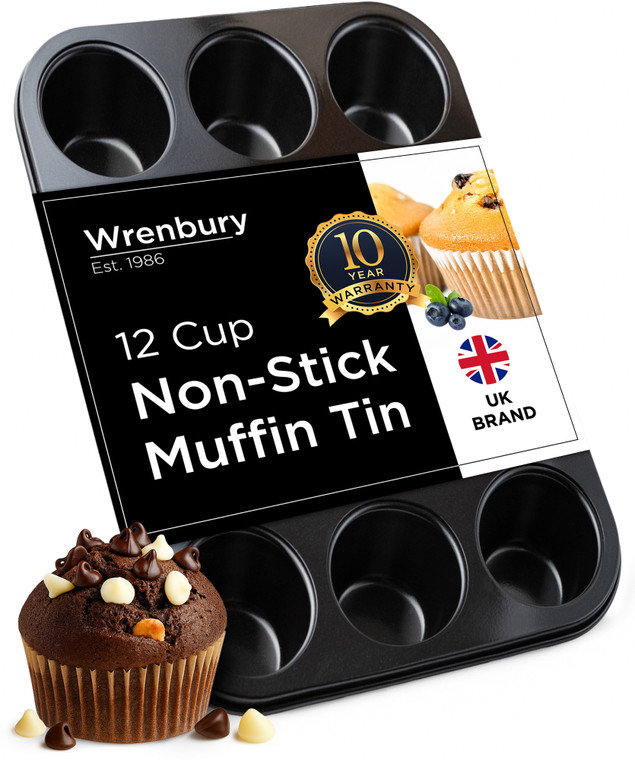
Non-Stick 12 Cup Muffin Tray
£21.99
Heavy carbon steel with PPG Eclipse coating — PTFE-free, PFOA-free, and built to last.
View product
1lb Loaf Tin
£13.99
The go-to tin for everyday loaves, banana bread, and air fryer baking — no PTFE in the coating.
View product
12 Cup Yorkshire Pudding Tin
£19.99
High-heat baking where PTFE-free actually matters most — with a 10-year warranty.
View productBrowse the full Wrenbury bakeware range, or filter by type: muffin and cupcake tins, loaf tins, Yorkshire pudding tins.
Frequently asked questions
Is PTFE-free bakeware actually non-stick?
Yes — but the coating still requires some care. PTFE-free coatings like PPG Eclipse and XYNFLON are engineered to release bakes cleanly when used correctly. A light brush of butter or oil before baking, silicone or wooden utensils, and hand washing will keep the surface releasing properly for years. The non-stick performance is reliable; it just isn't indestructible, which is true of any coated tin regardless of what the coating contains.
Is PTFE in bakeware dangerous?
At normal baking temperatures — below around 240°C — PTFE is stable. The concern arises at high temperatures, where the coating can begin to degrade and release fumes. The risk is much more acute for pet birds (where it can be fatal even at moderate temperatures) than for humans, but the question of long-term low-level exposure is one some bakers prefer to avoid altogether. PTFE-free removes that question rather than leaving bakers to manage temperature margins.
What's the difference between PTFE-free and PFOA-free?
They're completely different things. PFOA was the chemical used as a processing aid to manufacture and apply PTFE coatings — it was phased out globally around 2013–2015. PTFE is the non-stick coating material itself, and it's still present in most non-stick bakeware on the market. A product can be PFOA-free (and most now are) while still containing PTFE. To know whether a tin is PTFE-free, you need to see that stated explicitly — PFOA-free alone doesn't tell you.
Do all Wrenbury products contain no PTFE?
Almost all — with one exception. The baking tins (muffin trays, loaf tins, Yorkshire pudding tins, and the rest of the range) use PPG Eclipse or XYNFLON coatings, which are both PTFE-free and PFOA-free. The crumpet rings are the exception: they use a PTFE-based coating, so the correct claim for those is PFOA-free rather than PTFE-free. All other Wrenbury baking tins: no PTFE.
In short
The terms PTFE-free and PFOA-free are not interchangeable, and a lot of bakeware marketing blurs the line between them. PFOA-free tells you about the manufacturing process; PTFE-free tells you about the coating itself.
Whether you're concerned about high-heat degradation, you have a pet bird, or you'd simply rather not have the question in the back of your mind when you're baking — knowing what's actually in the coating on your tins is a straightforward thing to ask for. Wrenbury tins use named, verifiable coatings that are both PTFE-free and PFOA-free. The quality promise and 10-year warranty are there because we mean it.
If you want to read more about what goes into bakeware quality generally, the post on what makes quality bakeware covers material and gauge alongside coatings. And if warping is the thing that's been letting your baking down, the guide to bakeware that doesn't warp explains why it happens and what to look for.