
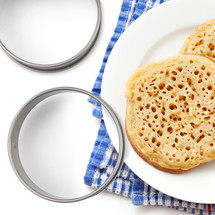
Posted by Mia Wren on 7th Aug 2026
Best Crumpet Rings UK: Which to Buy and Why
Crumpet rings look like the simplest thing you will ever buy for a kitchen. A metal circle. There is not much to get wrong.
And yet the search that brings most people here starts after something has gone wrong. Batter creeping out under the rim and setting into a lace collar across the pan. A crumpet welded to the ring so firmly it comes out in two pieces. Or a batch that turned out thin and pale when you wanted something tall enough to hold a proper amount of butter.
Almost all of that traces back to the ring rather than the batter. Rings sold as crumpet rings vary enormously in diameter, depth, weight and finish, and three of those four decide what comes out of the pan.
If you already own rings you are happy with and just want the method, our crumpet rings guide covers batter consistency, pan heat and getting the holes to open.
The four specifications that decide whether a ring works
Diameter: 9cm is the standard, and it matters more than it sounds
A proper crumpet is 9cm across, or three and a half inches in old money. That is not an arbitrary number. It is the traditional size, it is the size supermarket crumpets are made to, and it is also the diameter of an English muffin.
The trouble is that plenty of multi-packs contain rings at 7.5cm and 10cm, sometimes both in the same box, with no indication of which one is the crumpet ring. Bakers regularly end up with a kit and no idea which size the recipe assumes.
Here is what the difference does. Below about 7.5cm you are making something closer to a pikelet: it cooks faster, it holds less butter, and it will not fit an English muffin sandwich. Above 10cm the batter spreads too thin across the base before it sets, the holes open unevenly, and the middle stays gummy while the edges brown. Nine centimetres is where a normal ladle of batter sits deep enough to set from the bottom up and let the bubbles climb.
Buy 9cm. If a listing does not state the diameter in centimetres, that tells you something about the listing.
Depth: the specification almost nobody checks
Diameter gets all the attention. Depth is what decides whether your crumpet is tall or flat.
A crumpet ring should be around 3cm deep. Many rings sold for eggs are 1.5cm to 2cm, and a shallower ring cannot hold enough batter for a thick crumpet no matter how carefully you pour. You fill it to the brim, the batter rises over the top as the bubbles work, and it spills.
There is a related trap. Some wider rings are made no taller than the narrow ones in the same set, so both hold roughly the same volume of batter. The wide one spreads that volume across a bigger base and gives you a thinner crumpet. Compare the depth, not just the circle.
Weight and wall: the reason batter leaks
Batter escaping underneath is the most common complaint, and it is almost always a contact problem rather than a batter problem.
A light, thin-walled ring does not sit flush. It rocks on any slight unevenness in the pan, and loose batter finds the gap on the low side within seconds. A heavier ring in a rigid material has enough weight to seal against the pan by contact alone. You do not need a dough dam, a weight on top, or any of the other workarounds you will find suggested.
The coating
A crumpet sits against the inside wall of the ring for the whole cook and then has to release cleanly. Bare tinned steel works if you oil it properly every single time. A non-stick coating is considerably more forgiving.
Our rings use a PFOA-free non-stick coating. Worth being precise, because labelling in this category is loose: most of the Wrenbury range uses coatings that are PTFE-free as well, but the crumpet rings are the exception and we do not claim otherwise. For what those labels actually mean, see PTFE-free bakeware: what it means and why it matters.
Carbon steel, stainless or silicone
Carbon steel. Holds heat, holds shape, and takes a non-stick coating well. It is the traditional material for a reason. The one thing it asks in return is that you dry it properly, because carbon steel left sitting wet will eventually spot with rust. That is a thirty-second habit rather than a design flaw. Our comparison of carbon steel vs non-stick bakeware explains why the material underneath a coating matters as much as the coating.
Stainless steel. Rust-proof and durable. Rings tend to be either seamed and light, which brings back the leaking problem, or heavy and expensive. Nothing wrong with a good heavy stainless ring, but it has no coating, so it needs oiling with real attention every time.
Silicone. Avoid it for crumpets. Silicone flexes, which is the opposite of what you want from something whose entire job is holding a rigid shape against wet batter. The rings lift and float as the batter expands, and they seep at the base on anything but a perfectly flat pan. Fine for a fried egg. Not crumpet rings.
Cookie cutters. A circle is a circle, so they half work. They fail on depth, wall thickness and seams, and the seam is exactly where batter escapes.
The handle question
Some rings come with a handle. It sounds like an obvious improvement until you use them.
A handle means the rings cannot nest, so four rings take up four rings' worth of drawer. It also stops them sitting side by side tightly, which costs you one or two rings' worth of pan space in a batch. And the handle gets hot unless it is silicone, in which case it is bulky.
Rings without handles lift off with tongs or a folded tea towel, which takes a second. The full comparison is in egg rings vs crumpet rings, including the one job a handled egg ring genuinely does better.
How many do you need
More than people expect, and the reason is the pan rather than the appetite.
Crumpets take eight to ten minutes on the first side, so the number of rings in your pan is the number of crumpets you get per ten minutes. Two rings turns a batch into an hour.
Count what fits. A 24cm frying pan takes four 9cm rings comfortably; a 28cm pan or a flat griddle takes six. Four suits a couple's breakfast and a standard pan. Six is right for a family, a big pan, or anyone who has worked out that crumpets freeze well and a double batch takes barely any longer than a single one.

Non-Stick Crumpet Rings Set of 4
£17.99
Four 9cm by 3cm carbon steel rings, made in England, heavy enough to seal against the pan without help.
View product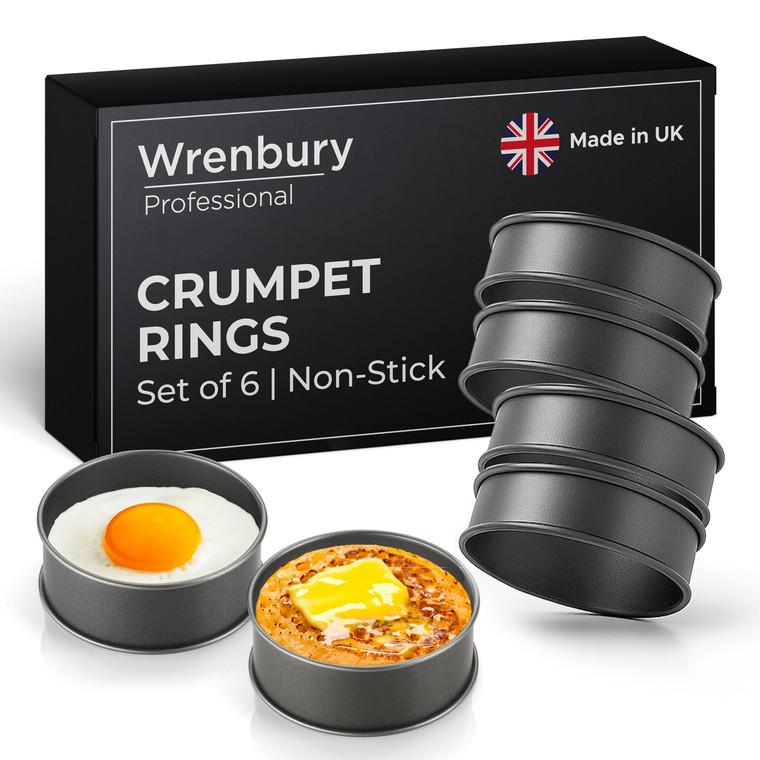
Non-Stick Crumpet Rings Set of 6
£19.99
The same rings in a set of six, which fills a large pan or a griddle in one go.
View productBoth sets carry the same 10-year guarantee as the rest of the range, covering coating failure and structural damage rather than fair wear. On a set of rings costing under twenty pounds that is unusual, and it is the clearest available signal that a manufacturer expects its own product to survive. Rings are cheap enough that most brands would rather you replaced them.
The crumpet rings are also the one thing we make in England rather than design here and manufacture abroad. If that matters to you, it is worth knowing which claim is which. The rest of the bakeware range is designed in England and made abroad, and we say so.
What still goes wrong with good rings
Buying properly removes most failures. Three survive, and all three are quick to fix.
Three fixes for sticking and leaking crumpets
- Heat the rings with the pan: rings are thin and heat fast, which makes it tempting to drop a room-temperature ring onto a hot pan and pour straight away. The batter meets cold metal, grips it, and tears on release. Put the rings in while the pan preheats so they come up to temperature together.
- Start with a spotless ring: a film of cooked batter left inside from last time will stick, coating or not. Clean rings release so well that the crumpet visibly pulls away from the wall as it cooks. That gap is how you know the ring was ready.
- Thicken the batter: thin batter runs under the rim before it has the structure to hold itself, and it gives you a flat crumpet with poor holes. If it pours like cream rather than dropping off the spoon in a thick ribbon, it needs less liquid.
Care, so they last
Wash by hand in warm soapy water with a sponge rather than a scourer. Anything stubborn should be soaked off rather than scrubbed off, because scrubbing is what takes coatings apart. Dry with a tea towel straight away rather than leaving them on the drainer. If you bake infrequently, a very light wipe of oil before they go in the drawer keeps the steel protected between uses.
The rings are dishwasher safe, though hand washing keeps the coating in better condition for longer. Our care and use guide covers the same ground for the rest of the range, and how to make your baking tray last 10 years goes further into the habits that quietly shorten a coating's life.
Frequently asked questions
Why does batter leak out from under my crumpet rings?
Nearly always because the ring is not sitting flush. A light, thin-walled ring rocks on any unevenness and the batter finds the gap on the low side. A warped pan does the same to any ring. Press the ring flat before pouring, use a heavier ring, and thicken the batter if it pours like cream. A small seep in the first few seconds that then cooks solid is normal.
Do crumpet rings need greasing if they are non-stick?
For the first few uses, yes. Brush a little oil around the inside wall while the coating settles in. After that you need very little, though a trace is still worth it because the crumpet is in contact with that wall for the full eight to ten minutes. Rings ask for more oil than a tin does, purely because of that long contact.
What size crumpet ring should I buy?
9cm across and 3cm deep. That is the standard size for a proper crumpet, and it is also the diameter of an English muffin, so the same rings do breakfast muffin eggs without buying a second set. Anything under 7.5cm makes pikelets rather than crumpets.
Will carbon steel rings rust?
Only if they are left wet. Dry them with a tea towel straight after washing rather than leaving them to air dry, and they stay in good order for years. An occasional light wipe of oil helps if you use them rarely. This applies to all carbon steel, which is the same trade-off you accept with a good frying pan.
Can I use crumpet rings in the oven as well as a frying pan?
Yes. They sit flat in a pan for crumpets and eggs on the hob, and they are oven safe for baked eggs, small rosti or neat rounds of anything that would otherwise spread. How to use crumpet rings like a pro runs through the rest.
Are handled egg rings a reasonable substitute?
For eggs, yes. For crumpets, usually not, because most are too shallow at 1.5cm to 2cm to hold enough batter for a thick crumpet, and the handles stop you fitting a full batch in the pan. It is the depth that rules them out rather than the handle.
The short version
Buy 9cm across and 3cm deep, in carbon steel, heavy enough to sit flush without help. Skip silicone and skip anything that will not tell you its dimensions. Count what fits your pan before choosing between four and six.
Get that right and the ring stops being a variable. What is left is batter and heat, which is where the interesting part of making crumpets lives.
Both sets are on the crumpet rings page. If you are still deciding whether homemade is worth the effort at all, crumpets vs English muffins and crumpets vs bread make the case better than a buying guide can. For everything else in the cupboard, our best bakeware UK guide covers the whole range.