
Posted by Mia Wren on 9th Sep 2026
Best Mini Bundt Tin UK: How to Choose a Fluted Ring Tin That Releases Cleanly
Baking little cakes should be one of the easy pleasures, and too often it ends in exasperation with half the cake still sitting in the tin's grooves. If you're shopping for a new mini cake tin, what you actually want is a clean release and even browning. Most of the time the tin is at fault long before you are.
(A quick note on the name: "Bundt" is a registered trademark belonging to Nordic Ware. That's why good British tins like ours are called fluted ring tins — same shape, same recipes, just a name anyone is free to use.)
Three of the four things that go wrong are decided before the tin ever reaches you.
Why so many mini tins fail
Most ruined batches aren't your fault. They're usually the fault of a supermarket tin that's been shoved to the back of the cupboard. Four things go wrong:
- The steel is too thin. This is the root of everything else. A stamped tin at 0.4–0.5mm buckles in the heat, and once it stops sitting flat the heat stops arriving evenly. The thin ridges scorch while the middle of the cake is still wet. There's more on why bakeware warps if you want the metallurgy.
- The coating gives up. When thin metal flexes, the bonded non-stick layer takes a stress it was never designed for. It crazes and lifts, and it goes at the flutes first — which is exactly where a cake tears. Our guide to quality bakeware and non-stick coatings covers what the different finishes actually are.
- The flutes are too shallow. The whole point of a fluted tin is that the shape does the decorating, so a dusting of icing sugar is enough. Shallow grooves give you a vaguely wavy dome that needs thick buttercream to look like anything.
- The greasing advice is wrong. And that one's on the recipes. Almost every one says to grease with butter, but butter carries water and milk solids that catch in the grooves and set like glue.
We know how the first two end because we watched it for years. In 2010 we bought a high street kitchen shop in Lincolnshire that had traded since 1986, and one of the jobs was standing at the returns counter.
Nobody ever came back with a heavy tin.
What to look for in a good one
- Weight. Heavy-gauge carbon steel — ours is 0.8mm — holds its shape and doesn't warp. When you're buying online and can't handle the thing, weight is the best proxy you have.
- A coating claim that's specific. Skip the vague listings. Our mini fluted ring tin has a non-stick finish made without PTFE or PFOA, and the Royal style tin's coating is PFOA-free. We list them separately because they aren't the same coating.
- Sensible cup size and count. Six generous 9.5cm portions is a better buy than twelve tiny cups, which just bake into a tray of dry little rings.
- A guarantee that covers the right things. Every Wrenbury tin carries a 10-year guarantee, and it names the two failures that actually happen: warping and coating damage in normal home baking. The full terms are here.
Our mini cake tins
All three mini cake tins share the same 9.5cm cup, so you can bake different shapes from one batch of batter in one go.
- Mini Fluted 6 Cup Cake Tin (£17.99). The deep-fluted classic. The one to buy if you're only buying one.
- Mini Dessert Fluted Cake Tin, Royal Style (£19.99). Steeper sides and a showier shape — made for Charlottes, set puddings and anything you'd plate up properly.
- Xtravaganza Baking Bundle (£36.99). Both of the above plus a jumbo donut pan. Three tins for less than two bought separately: £17.99 and £19.99 is £37.98.

Mini Fluted 6 Cup Cake Tin
£17.99
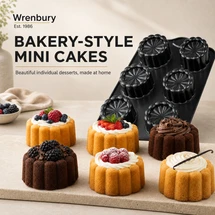
Six 9.5cm ring moulds in 0.8mm carbon steel, with flutes deep enough that icing sugar is all the decoration a cake needs.
View product
Mini Dessert Fluted Cake Tin, Royal Style
£19.99
Steeper fluted walls, shaped for Charlotte-style desserts and sponge fingers stood upright around the edge.
View product
Xtravaganza Baking Bundle
£36.99
Both fluted tins plus a six-cup jumbo donut pan. The two tins on their own come to £37.98.
View productIf the jumbo donut pan in that bundle appeals, the best donut pan UK guide covers that side of the range.
There's a fourth shape too, the mini swirl fluted tin, which twists the ridges rather than running them straight. It's out of stock as we write this — worth a look on the mini cake tins page if you're reading this later.
Seven steps to a clean release
These steps, and their order in particular, are what decide it.
Step six is the one nearly everyone gets wrong.
Seven steps to a clean release
- Use oil, not butter. Rapeseed oil or melted shortening gives you a clean release; butter doesn't.
- Grease with a pastry brush. Make sure fat gets right into every last groove.
- Grease just before you fill. Any earlier and it drains down the sides and pools in the base.
- Flour the tin for the first few bakes. Before the coating has bedded in, dust the greased tin and tap the excess out. Ground almonds or caster sugar leave a nicer crust than plain flour.
- Fill only two-thirds full. Overfilled batter swells over the rim and grips the top edge as it cools.
- Wait exactly ten minutes. Not five, not thirty. In ten minutes the cake shrinks back just enough to release, without setting hard against the metal. This is the step most people skip.
- Turn out in one confident movement. Straight onto a rack, no hesitating and no pointless tapping.
Baking tips and care
Mini cakes bake surprisingly fast, because there's a lot of surface exposed to the oven and very little distance to the centre. Start checking at two-thirds of the recipe's stated time. If you're scaling a large cake recipe down into small tins, drop the oven by 10°C.
The tins are technically dishwasher safe, but wash them by hand with a soft sponge and washing-up liquid. Dishwasher detergent is abrasive by design and wears the coating out of the grooves. Dry properly straight after washing — carbon steel doesn't like sitting damp. How to make your baking tray last 10 years covers the care side properly, and the care and use guide is the short version.
For batter, glazes and what to do when a sponge cracks, the complete mini bundt cakes guide goes further. For ideas rather than technique, raid elegant little desserts you can actually bake at home.
Common questions
Do mini cakes always stick in the ridges?
Only under-greased ones. Brush oil or melted shortening into every flute instead of butter, flour the tin for the first few bakes, and rest the cakes ten minutes before turning out. On a decent tin, sticking is nearly always a greasing problem.
How much batter does one cup hold?
A 9.5cm cup takes roughly what two ordinary muffins would, so a typical 12-muffin recipe fills a six-cup tin perfectly.
Does carbon steel rust or warp?
Heavy carbon steel doesn't warp — that's a thin-tin problem. Rust is a drying problem: wash it, dry it and store it dry, and it'll last for years.
Can you make anything other than cake in them?
Certainly. Bread rolls, rice or cous cous moulds, small rum babas and set desserts like panna cotta all work well. The Royal style tin in particular was designed for cold desserts.
Is it worth buying two at once?
If you bake for more than six, yes. Raising agent won't wait in the bowl while the first batch bakes and cools. Two tins means the whole batter goes in at once, and the Xtravaganza bundle is the cheapest way there.
The short answer
Buy on weight. Everything else — the browning, the coating, the release — follows from whether the metal holds its shape. Get a heavy one, grease the flutes with oil rather than butter, and give it ten minutes before you turn it out.
Ours are on the mini cake tins page, and the wider range is in the best bakeware UK guide if you're building a cupboard rather than buying one tin.