
Posted by Mia Wren on 7th Aug 2026
How to Make Crumpets from Scratch
The first batch I made from scratch came out like flat, pale discs with a rubbery lid and not a hole in sight. They tasted of raw flour. I had done the classic thing: rushed the rest, cranked the heat, and assumed a crumpet was basically a thick pancake. It is not. A crumpet is a batter, not a dough, and almost everything that makes it work happens in two places most people get wrong: the consistency of the batter and the temperature of the pan.
Get those two right and crumpets are genuinely easy. You need flour, yeast, a bit of patience, and something to hold the batter in a round while it sets. Here is how to make a proper one, with the honey-trap holes, a soft open crumb, and a base that browns instead of welding itself to the pan.
What actually makes a crumpet a crumpet
The holes are the whole point, and they are not decoration. When yeast ferments the wet batter it produces gas. Because the batter is loose and slightly stretchy, that gas rises up through it in columns and breaks the surface as bubbles. A pinch of bicarbonate of soda, stirred in right at the end, gives a second burst of lift that widens those channels. The bubbles set open as the crumpet cooks, and that is what gives you the tunnels that hold melted butter.
For that to happen the batter has to be pourable, not spoonable. Think thick double cream that slowly drops off a spoon in a ribbon, not a scone dough you could pat into shape. Too thick and the gas cannot push through, so you get a dense, cakey crumpet with a smooth top. Too thin and the batter runs out under the ring and never builds enough structure to trap the bubbles. Most first-time failures are a batter that is too stiff.
The second half of the job is the pan. Crumpets cook low and slow from one side only, for a long time by frying standards, so the inside can set before the base burns. A cold pan and a hot flame both cause the same misery: batter that leaks under the ring, a base the colour of mahogany, and a middle that is still wet.
What you need
Nothing exotic. Strong white bread flour gives you the stretch that holds the holes open, better than plain flour. Instant (fast-action) yeast saves a step. You want warm milk and water for a soft flavour, though all water works fine. And you need rings to contain the batter, because left to its own devices a crumpet batter spreads into a thin lace pancake.
You can improvise rings from scrubbed food tins with both ends removed, but they have sharp seams, no coating, and a habit of tipping over. Purpose-made crumpet rings sit flat, hold their shape, and release cleanly, which matters a lot when you are lifting a set crumpet off a hot pan.

Crumpet Rings, Set of 4
£17.99
Straight-sided carbon steel rings, 9cm across and 3cm deep, that sit flush and release cleanly. Made in England, PFOA-free non-stick, 10-year guarantee.
View product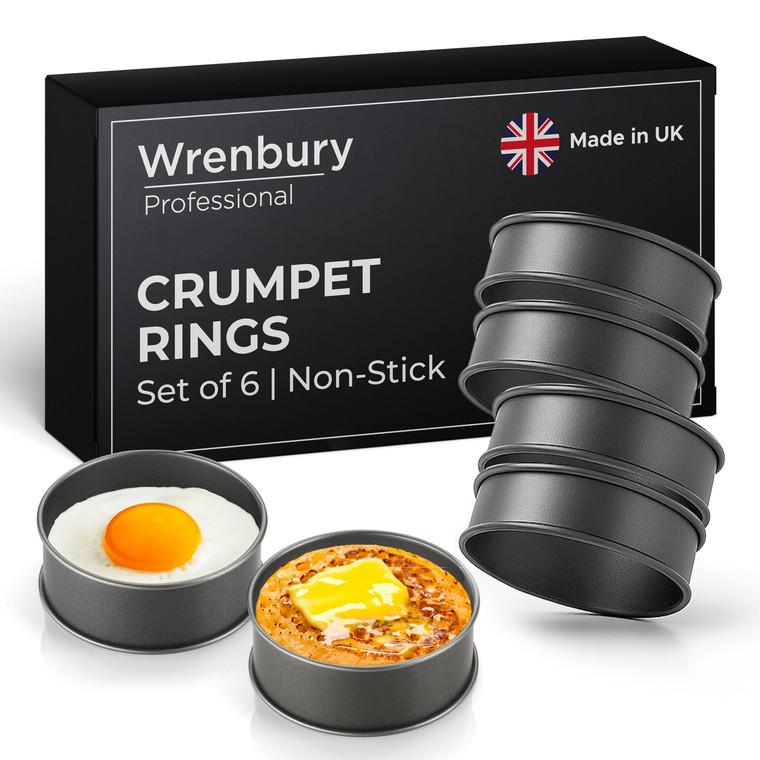
Crumpet Rings, Set of 6
£19.99
Six rings to fill the pan and cook a full batch at once, rather than going round in shifts. PFOA-free non-stick, 10-year guarantee.
View productWrenbury crumpet rings are made in England and carry the same 10-year guarantee as the rest of the range. The non-stick is PFOA-free, and because the rings are properly rigid they sit flat on the pan instead of rocking, which is half the battle with batter escaping underneath. If you want the full run of what they do beyond crumpets, our guide to using crumpet rings goes through it.
The recipe
Makes about 8 to 10 crumpets, depending on ring size.
- 300g strong white bread flour
- 7g fast-action dried yeast (one sachet)
- 1 tsp caster sugar
- 1 tsp fine salt
- 300ml warm milk
- 150ml warm water, plus a splash more if needed
- 1/2 tsp bicarbonate of soda
- Butter or a neutral oil, for greasing
The milk and water want to be warm to the touch, around blood temperature. Too hot and you will kill the yeast before it starts.
How to make crumpets from scratch
- Mix the dry ingredients: Whisk the flour, yeast, sugar and salt together in a large bowl and make a well in the middle.
- Make the batter: Pour in the warm milk and most of the water, whisking to a smooth, lump-free batter. Aim for the texture of thick double cream that falls off the whisk in a slow ribbon. Add the last of the water only if it is too stiff.
- Rest until bubbly: Cover the bowl and leave it somewhere warm for about an hour, until the surface is covered in bubbles and the batter has risen and looks foamy. This is the rest that does the work. Do not skip it.
- Add the bicarbonate of soda: Dissolve it in a tablespoon of warm water and stir it through the batter. It will fizz and loosen slightly. Leave it another 10 to 15 minutes.
- Grease and warm the pan: Grease the inside of each ring and the pan itself with a thin film of butter or oil. Set the rings on the pan and warm both over a low to medium-low heat for a couple of minutes before any batter goes in. A warm pan is what stops the batter escaping underneath.
- Fill the rings: Spoon or pour batter into each ring to just under halfway, roughly 1.5 to 2cm deep. Resist filling them higher.
- Cook until the holes open: Cook, undisturbed, for 8 to 10 minutes. Bubbles will rise and pop across the top, leaving holes. The crumpet is ready to turn when the surface has lost its shine and looks set and dry, with holes that stay open.
- Lift the rings and flip: Lift the rings away with a cloth or tongs to save your fingers. Flip each crumpet and cook the top side for just 1 to 2 minutes, only to set and lightly colour it.
- Cool, then toast: Cool on a wire rack. Crumpets finish setting as they cool, so eating one straight off the pan is how you convince yourself it is underdone when it is not. To serve, toast until crisp and butter generously so it sinks into the holes.
Troubleshooting: why crumpets go wrong
Most crumpet problems come back to batter or heat. Here is how to read what went wrong.
No holes, smooth top. Either the batter was too thick for gas to travel through, or the yeast was old and did not produce enough gas in the first place. Check the batter was properly bubbly after its rest. If it never foamed, the yeast is the suspect. Loosen the next batch with a splash more water and make sure it rises before you cook.
Batter runs out under the ring. Three usual causes, in order of likelihood. The pan was cold when the batter went in, so it stayed runny long enough to find the gap. The batter is genuinely too thin, so stir in a spoonful of flour. Or the pan is warped so the ring cannot sit flush against it, which leaves a permanent gap on one side. A flat, heavy pan and rings that hold their shape solve this between them, and looking after good bakeware is what keeps it flat. Our guide on how to make your bakeware last 10 years covers the habits that keep a pan sitting true.
Gummy or raw in the middle. The heat was too high, so the base set before the inside could cook, or the rings were overfilled. Drop the heat, fill the rings only to just under halfway, and give them the full 8 to 10 minutes on the first side. If you have already cooked a batch and they are doughy inside, split and toast them: it finishes the middle without ruining the texture. And let them cool fully before you judge them, because a warm crumpet always feels slightly moist inside.
Sticking to the rings. Grease the inside wall of each ring properly, and re-grease between batches. A clean, well-coated ring lets the set crumpet drop straight out. This is where a coated ring earns its place over a sawn-off tin, which grips the batter along its seam.
Pale, flabby crumpets. The heat was too low, or you flipped them too early. The base should be golden and the top set before you remove the ring. The brief flip at the end is only to dry the top, not to cook it through.
Rings, and what else they are good for
If you are buying rings for the first time, a set of coated rings that sit flat and release cleanly will save you more grief than any single change to the recipe. The rings also do a lot beyond crumpets: neat poached eggs, home-made English muffins, potato rösti, and tidy stacked pancakes. If you are weighing up rings against the egg-ring versions sold for frying, our comparison of egg rings and crumpet rings explains which suits which job, because they are not quite interchangeable.
And if you are still deciding whether crumpets are worth the effort over a simpler bake, crumpets versus bread and crumpets versus English muffins both make the case, and neither of them requires you to master the holes on the first go. When you are done, a quick look at the care and use guide keeps your rings in good order for the next batch.
Frequently asked questions
Why don't my crumpets have holes?
The two usual reasons are a batter that is too thick, so the gas cannot rise through it, or yeast that did not do its job. After the hour-long rest, the surface should be covered in bubbles. If it is, and you still get no holes when cooking, loosen the batter with a little more water: it should pour in a slow ribbon, not sit in a mound. If the batter never foamed during the rest, your yeast is likely dead and needs replacing.
Do you flip crumpets?
Only briefly, and only at the end. Crumpets cook almost entirely from the base, which is why the top ends up full of holes and the bottom goes golden. Once the top has set and lost its shine, lift the ring and flip the crumpet for one to two minutes just to dry and lightly colour the top. Flipping early, or cooking the top for long, gives you a sealed lid and no holes.
Why does the batter leak out under the ring?
Most often because the pan was cold when the batter went in. Warm the greased rings on the pan for a minute or two first, so the batter starts to set the moment it lands. If it still leaks, the batter may be too thin (add a spoonful of flour), or the pan may be warped so the ring cannot sit flush. A flat, heavy pan and rings that hold their shape solve this between them.
What is the bicarbonate of soda for?
It is a second raising agent that gives a burst of lift right before cooking, on top of the slower work the yeast has already done. Stirred in after the rest, it widens the bubble channels so the holes are bigger and more open. It also lifts the flavour slightly. Half a teaspoon dissolved in warm water is plenty for this quantity.
Can I make crumpets without rings?
You can, but they spread thin and lacy rather than tall with a defined edge, which is really a different thing. Rings are what give a crumpet its straight sides and its depth, and that depth is what holds the open crumb. If you want the proper article, use rings.
How do I store and reheat them?
Cool them fully, then keep them in an airtight container for two to three days, or freeze them once cold. Crumpets are meant to be toasted, so reheating is a feature, not a chore: straight from frozen into the toaster is fine. Do not refrigerate them, as that dries them out faster than the freezer.
The short version
Make a loose, pourable batter, let it rest until it is properly bubbly, stir in the bicarb, and cook it low and slow in greased rings on a warm pan. Wait for the holes to open and the top to set before you flip. Nearly every crumpet failure is either a batter that is too thick or a pan that is too hot, and both are easy fixes once you know to look for them.