
Posted by Mia Wren on 17th Sep 2026
How to Make English Muffins at Home (With Crumpet Rings)
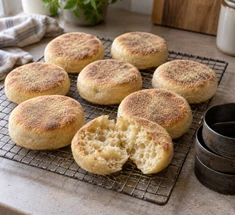
Shop-bought English muffins are a bit sad, aren't they. Dry, no holes to speak of, and stale the day after you open the packet. So one Saturday I made my own, because it's flour, yeast, milk and a frying pan, how hard can it be. They came out golden on both sides and when I pulled one apart the middle was still dough. The kids ate the outsides like biscuits and I stood at the hob wondering how five ingredients had beaten me.
I don't really do recipes. I bake by feel and mostly get away with it, and when I don't I blame the oven. These were the first thing in ages I couldn't bluff, so batch two I weighed everything, turned the heat right down, and used rings.
Which brings me to the rings, because I'd wasted an evening hunting for "English muffin rings" online and every result was an American shop wanting to post them across the Atlantic. Nobody in this country calls them that. We call them crumpet rings, and I had six in the drawer under the hob the whole time.
Do you actually need rings?
It is not mandatory and plenty of people shape the dough by hand and cook it loose on the pan, and if the dough is firm enough it holds its shape fine.
The trouble is that with firm dough you kind of get more of a bread roll consistency. The holes inside a proper English muffin, the ones the butter disappears into, only happen if the dough is wet and sticky and slightly annoying to handle. And a wet dough on a hot pan doesn't stay put. It slumps outwards and you get something thin and wonky that looks like it's been sat on.
A ring means you can have the wet dough and still get a muffin that's tall and round and the same size as the other seven, and eight muffins the same size all cook through at the same time. Which, as you'll see, is the whole problem with these things.
Wrenbury rings are 9cm across and 3cm deep, and they carry the same 10-year guarantee as everything else we make. The 3cm is worth checking if you buy elsewhere, because a lot of the cheap "muffin rings" out there are barely over 1cm deep and the dough just rises up and over the top. If you're deciding between sets, we've gone through which crumpet rings to buy separately.

Non-Stick Crumpet Rings Set of 4
£17.99
Four 9cm rings, 3cm deep, in rigid carbon steel with a PFOA-free non-stick coating. Made in England, guaranteed for ten years.
View product
Non-Stick Crumpet Rings Set of 6
£19.99
Six rings for a full batch across two pans, same carbon steel and PFOA-free coating.
View product
The Breakfast Set
£39.99
Four crumpet rings, a four-cup Yorkshire pudding tray and a 2lb loaf tin in one box.
View productThe recipe
Makes eight muffins, 9cm across.
- 400g strong white bread flour
- 7g fast-action dried yeast (one sachet)
- 1 tsp caster sugar
- 1½ tsp fine salt
- 250ml milk, warm to the touch
- 50ml water, warm
- 25g butter, melted
- Fine semolina or polenta, for dusting
- Butter or a neutral oil, for the rings
You do want bread flour rather than plain. I've made them with plain when it was all I had and they were fine, but soft and a bit cakey, without the chew that makes them worth splitting. The semolina is doing a job too. It stops the dough sticking to the tray and the pan, and it gives the outside that faint gritty crunch you get on a shop-bought one.
How to make them
How to make English muffins with crumpet rings
- Mix the flour, yeast, sugar and salt in a large bowl. Pour in the warm milk, water and melted butter and bring it together into a soft, sticky dough.
- Knead for eight minutes, in a mixer with a dough hook or by hand with a scraper. It's going to be sticky and the temptation is to keep adding flour until it behaves. Please don't, because the stickiness is where the holes come from. Wet your hands instead.
- Cover and leave somewhere warm for about an hour, until it's doubled. Or put it in the fridge overnight and shape it in the morning.
- Dust a baking tray generously with semolina. Grease the inside of each ring with butter or oil and set the rings on the tray.
- Divide the dough into eight pieces, about 95g each. Shape each one into a ball, press it down to a disc about 2cm thick, and drop it into a ring. Dust the tops with semolina too.
- Leave them to prove for 30 to 40 minutes, until the dough has risen to roughly the height of the ring. People skip this rest because they're hungry by now, and it's the one that gives you the height. Muffins that go straight from shaping to the pan come out tight and short.
- Heat a heavy frying pan over a low to medium heat, with nothing in it. Slide the rings across, dough and all, and put a lid on for the first three minutes.
- Cook for 8 to 10 minutes, until the underside is a deep golden brown. Lift the rings away with tongs, flip the muffins, and give the second side another 8 to 10 minutes.
- Tap one on the top. It should sound hollow, and if you've got a probe it wants to read 93°C in the middle. If the outsides are dark and the middle isn't there yet, put them on the tray in the oven at 180°C for 8 to 10 minutes.
- Cool them on a rack for at least 15 minutes, then split them with a fork rather than a knife. A knife cuts straight through the bubbles and a fork tears along them, and that torn surface is where all the texture is.
Why they come out raw in the middle
Mine did, and having read a lot of forums since, I'm in good company. Nearly every time it comes down to the pan being too hot. An English muffin is a fat lump of dough sitting on hot metal, and if the metal is too hot the bottom goes brown long before the heat has crawled through to the centre. Then you flip it and do the same thing to the other side, and you end up with something that looks finished and isn't.
The fix is a lower heat than you'd use for a pancake, for a lot longer than feels reasonable. On my hob that's the second-lowest setting and eight minutes a side, which the first time felt like I'd forgotten about them. If your hob runs hot, start with the pan barely warm. The lid in the first few minutes traps steam and gets some heat into the top while the bottom is setting, so the middle isn't relying on one side to do all the work.
Weigh the pieces as well. I divided my first batch by eye and two of them were enormous, and those two came out as bread pudding while their smaller neighbours were fine.
Why they come out dense
If yours are more roll than muffin, with a tight crumb and no holes, you either added flour during the knead or you rolled it out and cut rounds with a cutter, which flattens the air out, and then re-rolling the scraps flattens it again. Or maybe you skipped the second prove.
All three have the same answer, which is to leave the dough wet, shape it gently with your hands, and let the ring hold the shape instead of a stiff dough doing it. If you want holes the size of your fingernail, let the first rise go a bit long, until it's just starting to sag in the middle. A slightly over-proved dough makes a better English muffin than an under-proved one, which is the opposite of most bread and took me a while to believe.
A few notes on the rings
Grease them every batch, even the coated ones, and a wipe of butter round the inside with your finger is plenty. You'll see a lot online about batter escaping under rings, and that's a crumpet thing rather than a muffin thing, because this dough is far too thick to run anywhere. When it does happen with crumpets it's usually the pan not sitting flat rather than the ring, and we've covered why in why baking tins and pans warp.
Carbon steel rings need drying straight after they're washed or they'll spot, so give them thirty seconds with a tea towel rather than leaving them on the draining board overnight like I do with everything else. Ours can go in the dishwasher, but a hand wash keeps the coating going longer, and the care and use guide has the rest.
Egg rings will work too, if that's what you've got, though they're shallower so the muffins come out flatter, and the handle stops the lid sitting down. The differences are in egg rings vs crumpet rings if you're deciding.
And if you've got this far and are now wondering whether you should just have made crumpets, crumpets vs English muffins will settle it, and how to make crumpets is the batter version of this recipe in the same rings. They also do eggs, rösti and small pancakes, which is written up in what else crumpet rings do.
Common questions
Do I need rings to make English muffins?
No, but they make the wet, holey version a lot easier. Without rings you need a firmer dough so it holds its shape on the pan, and a firmer dough gives you fewer holes. With 3cm rings you can use a sticky dough at about 75% hydration and still get eight muffins the same size.
Are crumpet rings the same as English muffin rings?
Yes, it's the same 9cm ring sold under a different name. American shops call them English muffin rings and British shops call them crumpet rings. The thing worth checking is depth, because a muffin ring wants to be around 3cm deep so the dough rises inside it rather than up and over it.
Why are my English muffins raw in the middle?
The pan was too hot, or the muffins were too thick, or both. Cook them on a low to medium heat for 8 to 10 minutes a side with the lid on at the start, keep the dough at about 2cm thick before proving, and check the middle with a probe if you have one. If they've browned and the middle is still doughy, 8 to 10 minutes in a 180°C oven finishes them off.
Why are mine dense with no holes inside?
Usually because flour got added during the knead, or the dough was rolled and cut, or it didn't get its second prove. Keep the dough sticky, shape it by hand rather than rolling and cutting, and give it the full second prove in the rings. Splitting with a fork instead of a knife makes a surprising difference as well.
Can I use plain flour instead of strong bread flour?
You can, but they'll be softer and more cake-like with less chew. Strong flour has more gluten, which is what stretches around the bubbles and holds them open. If plain is all you have, knead it a couple of minutes longer.
Do I have to finish them in the oven?
No. On a low heat with a lid on they'll cook through on the pan alone. The oven is there to rescue a batch that's gone too dark outside before the middle has caught up, which is what happened to my first lot. Some people will tell you that's cheating, and I'd rather cheat than eat raw dough.
The short version
Keep the dough wet and don't add flour to it. Prove the shaped dough in the rings on a semolina-dusted tray until it fills them, then cook on a low heat with the lid on for 8 to 10 minutes a side, and split with a fork.
I still don't follow recipes for most things, but for these I get the scales out and set a timer, and I've not had a raw one since.