



Posted by Mia Wren on 17th Feb 2026
Mini Bundt Cakes — The Complete Guide to Baking, Releasing and Decorating
A bundt cake is one of the most satisfying things you can bake. The tin does most of the decorating for you — that distinctive fluted ring shape looks impressive without any piping, layering, or fiddly icing work. And when you scale it down to mini bundts, you get individual portions that look like they came from a bakery, using nothing more than a good tin and a simple batter.
There is, however, one catch. Search for "bundt cake" online and you'll find the same questions repeated over and over: why did it stick? how do I get it out in one piece? how do I decorate it without ruining the shape?
This guide covers all of it — from the history of the bundt shape to a reliable recipe, the greasing method that actually works, and three quick decoration ideas that suit mini bundts perfectly.
What exactly is a bundt cake?
A bundt cake isn't a recipe. It's a shape — a ring with a hollow centre, baked in a fluted tin with a central tube. The shape means more of the batter is in contact with the tin, so heat reaches the middle faster and you get a more even bake than you would from a deep round tin.
You can bake almost any dense or semi-dense cake batter in a bundt tin: sponge, marble, chocolate, lemon drizzle, carrot cake, even some pound cakes and fruit cakes. If the batter holds its structure well and isn't too light or mousse-like, it'll probably work in a bundt.
Where does the bundt come from?
The ring-shaped cake has deep European roots. In Germany and Austria, the Gugelhupf (also spelt Kugelhopf in Alsace) has been baked in fluted ring moulds — originally ceramic, later metal — for centuries. It's a yeasted, often fruit-studded cake that's been a staple of Central European baking since at least the 1600s.
The word "bundt" itself is American. In the 1950s, a company called Nordic Ware in Minneapolis began manufacturing cast aluminium ring pans based on those European moulds. They trademarked the name "Bundt" and started selling them across the United States — but sales were modest at first.
The turning point came in 1966. A home baker named Ella Helfrich entered a chocolate cake called the "Tunnel of Fudge Cake" into the Pillsbury Bake-Off competition and won second place. The recipe went viral (by 1960s standards), and demand for bundt pans exploded overnight. Nordic Ware reportedly sold over 50 million of them in the years that followed.
So to sum up: the shape is European, the brand name is American, and the concept has been around for a very long time.
Why mini bundts?
Everything that makes a full-sized bundt appealing works even better at individual scale:
- Portion control is built in. Everyone gets their own cake — no slicing, no uneven portions, no "I'll just have a thin piece" pretending.
- They bake faster. A full bundt can take 50–60 minutes. Mini bundts are done in 15–25 minutes, depending on the recipe.
- They look special with almost no effort. A simple drizzle of glaze or a dusting of icing sugar on a mini bundt looks like you've been to a patisserie. The fluted shape does the heavy lifting.
- Brilliant for gifts and entertaining. Pop them in a little box or bag and they're a genuinely thoughtful homemade gift. A tray of six different flavours makes a lovely tasting selection for a dinner party.
The number one problem: cakes that stick
Let's address this straight away, because it's the thing that puts people off bundt baking more than anything else.
Bundt tins — especially decorative ones with deep fluting — have lots of surface detail. That detail is exactly what makes the finished cake look so good, but it also creates more opportunities for the batter to grip the tin and refuse to come out cleanly. A stuck bundt doesn't just look disappointing; it often breaks apart entirely.
The good news: this is almost entirely preventable with the right preparation.
The greasing method that works
There are various approaches, and everyone has a preference, but this is the most reliable method for decorative fluted tins:
- Brush with softened butter. Use a pastry brush (not your fingers — you need to get into every crevice of the fluting). Make sure every surface is covered, including the central tube and the rim.
- Dust with flour. Add a tablespoon of plain flour, then tilt and rotate the tin so the flour coats every buttered surface. Tap out the excess. Every nook should have a thin, even coating.
- For chocolate cakes: dust with cocoa powder instead of flour. This avoids the white powdery residue on a dark cake. Same technique — butter first, then cocoa.
What about baking spray? Spray-on products with added flour (like Cake Release or similar) can work well for simple shapes. For deeply fluted mini bundts, though, the brush-and-dust method tends to be more reliable because you can physically see that you've reached every surface. Sprays can miss hidden crevices.
The release technique
Even with perfect greasing, the way you release the cake matters enormously.
- Don't rush. When the cakes come out of the oven, leave them in the tin for 10 minutes. Not 2, not 20 — about 10. This lets them firm up enough to hold together, but they're still warm enough that the fat keeps them mobile.
- Place a wire rack (or board) over the tin and flip. One confident movement.
- Give a gentle tap. If the cakes don't drop straight out, tap the base of the tin firmly a few times. Gravity and warmth will do the rest.
- Lift the tin away slowly. Straight up, no twisting.
If you've greased properly and timed it right, each mini bundt should release cleanly with all its fluted detail intact. It's a genuinely satisfying moment.
Your tin matters. A heavy-gauge non-stick tin makes a real difference here. Thin tins warp in the oven (which means uneven contact and sticking), and poor-quality non-stick coatings degrade quickly, especially in the detailed fluting where you need them most. Carbon steel with a proper non-stick finish gives the most consistent release — and it conducts heat evenly, which means a better bake as well as an easier turn-out.
Fill level and bake time for mini bundts
Two common mistakes with mini bundts: overfilling (which causes the batter to dome and overflow) and overbaking (which dries them out).
How full should you fill them?
Two-thirds full. No more. The batter needs room to rise. Overfill a mini bundt cup and the cake will mushroom over the top, lose its shape, and potentially stick to the flat surface of the tin between the cups.
If you're not sure, err on the side of less rather than more. A slightly under-filled mini bundt still looks lovely. An overfilled one looks a mess.
How long do mini bundts take to bake?
This depends on the recipe and your oven, but as a general guide:
| Cake type | Approximate bake time (mini bundt) | Oven temp |
|---|---|---|
| Vanilla / lemon sponge | 18–22 minutes | 170°C fan |
| Chocolate | 18–22 minutes | 160–170°C fan |
| Marble / tiger cake | 20–25 minutes | 170°C fan |
| Dense / fruit-based | 22–28 minutes | 160°C fan |
Start checking at the lower end. Insert a skewer or cocktail stick into the thickest part of one cake — if it comes out clean (or with just a few moist crumbs, not wet batter), they're done. Better to pull them a minute early and let the residual heat finish the job than to overbake them.
Remember: mini bundts are small, so they dry out faster than a full-sized cake. If your recipe was written for a large bundt (45–55 minutes), you'll typically need to reduce the bake time by more than half.
How to stop bundt cakes being dry
"Bundt cake is always dry" is something you hear a lot — and it's a shame, because it doesn't have to be. The issue is usually one of three things:
Overbaking. The most common culprit by far, especially with minis. See the timing guide above and start checking early.
Not enough fat or moisture in the recipe. Bundt cakes benefit from recipes that are slightly richer than a standard sandwich sponge. Sour cream, yoghurt, buttermilk, and oil-based batters all help keep the crumb moist. Butter alone can produce a slightly drier result — many of the best bundt recipes use butter and something else for moisture.
No syrup or soak. This is the trick that professional bakers use and home bakers often skip. While the cakes are still warm, brush or drizzle them with a flavoured syrup — even a simple one made from equal parts sugar and water, heated until dissolved. Lemon juice, coffee, rum, or orange zest in the syrup adds flavour as well as moisture. The warm cake absorbs it like a sponge.
Quick syrup formula: 50g caster sugar + 50ml water + flavouring of your choice. Heat in a small pan until the sugar dissolves. Brush over warm cakes immediately after turning them out. This alone transforms a good bundt into a brilliant one.
Three ways to decorate mini bundts (without ruining the shape)
The whole point of a bundt tin is that the shape is the decoration. Heavy buttercream or thick fondant hides the fluting — which defeats the purpose. Here are three approaches that enhance the shape rather than covering it up.
1) The simple glaze drizzle
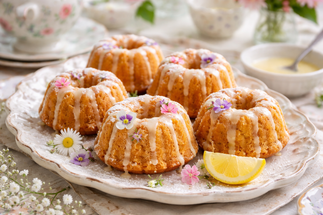
This is the most popular decoration by a mile, and for good reason: it highlights the fluted pattern beautifully and takes about two minutes.
How to do it: Mix icing sugar with a small amount of liquid (lemon juice, milk, or water) until you have a thick but pourable consistency — think natural yoghurt. It should fall from a spoon in a slow, steady stream, not run like water.
Place the cooled cakes on a wire rack over a tray (to catch drips). Pour the glaze slowly from a jug or squeeze bottle, letting it run down the fluted sides naturally. Don't spread it with a knife or spatula — the uneven, drippy effect is exactly what you want. It looks artisan, not messy.
Flavour ideas: lemon juice + icing sugar for a classic citrus glaze; espresso + icing sugar for a coffee version; orange juice + a pinch of cardamom for something a little different.
2) Icing sugar dust (with or without a stencil)
The simplest option of all: a light dusting of icing sugar through a fine sieve. It settles into the fluting and creates beautiful contrast, especially on a darker cake like chocolate or gingerbread.
For a more dramatic effect, lay a doily, a strip of lace, or a paper stencil across the top before dusting, then carefully lift it away. The pattern transfers onto the cake and looks remarkably professional for about 30 seconds of actual effort.
3) The half-dip (modern look)
Dip the top half of each mini bundt into a bowl of glaze or melted chocolate, let the excess drip off, then set them on a rack to firm up. The contrast between the glazed top and the bare, fluted bottom half is striking — very "artisan bakery."
Finish with a few freeze-dried raspberries, a sprinkle of crushed pistachios, or a pinch of flaky sea salt before the glaze sets. This works particularly well for gifts or when you're making a selection of different flavours and want them to look cohesive.
Recipe: Foolproof Mini Bundt Cakes
Makes 6 mini bundts.
This is a straightforward vanilla sponge that's specifically designed to be moist, hold its shape, and release cleanly from a fluted tin. Once you've got this base down, the flavour variations are endless (see below).
Ingredients:
- 150g unsalted butter, softened
- 150g caster sugar
- 3 medium eggs
- 150g self-raising flour
- 2 tbsp sour cream or natural yoghurt
- 1 tsp vanilla extract
- Pinch of salt
For the syrup (optional but recommended):
- 50g caster sugar
- 50ml water
- 1 tbsp lemon juice or 1 tsp vanilla extract
Method:
- Preheat your oven to 170°C fan / 180°C conventional / Gas Mark 4.
- Prepare the tin. Brush every surface of your 6-cup mini bundt tin with softened butter using a pastry brush. Dust with flour (or cocoa for chocolate variations), tapping out the excess. Every crevice needs to be coated.
- Cream the butter and sugar together until pale and fluffy — a good 3–4 minutes with an electric mixer.
- Add the eggs one at a time, beating well after each. If the mixture starts to curdle, add a tablespoon of the flour to bring it back.
- Fold in the flour and salt gently with a large metal spoon or spatula. Don't overmix — stop as soon as there are no dry streaks.
- Stir in the sour cream and vanilla. The batter should be thick but smooth.
- Divide evenly between the 6 cups, filling each about two-thirds full.
- Bake for 18–22 minutes until risen, golden, and a skewer inserted into the centre comes out clean.
- Rest in the tin for 10 minutes. Meanwhile, make the syrup: heat the sugar and water in a small pan until dissolved, then add the lemon juice or vanilla.
- Turn out onto a wire rack by placing the rack over the tin and flipping confidently. Tap the base if needed.
- Brush the warm cakes with syrup immediately. Let them absorb it as they cool.
- Decorate once completely cool — glaze, dust, dip, or leave them beautifully bare.
Flavour variations (from one base recipe)
One of the best things about mini bundts is making a selection of flavours from the same basic batter. Here are five that work reliably:
| Flavour | What to change | Glaze suggestion |
|---|---|---|
| Lemon | Add zest of 2 lemons to the batter; use lemon juice in the syrup | Lemon juice + icing sugar |
| Chocolate | Replace 30g flour with cocoa powder; dust tin with cocoa | Melted dark chocolate drizzle |
| Orange & almond | Add zest of 1 large orange + 50g ground almonds (reduce flour by 50g) | Orange juice + icing sugar |
| Espresso | Dissolve 2 tsp instant espresso in the sour cream before adding | Espresso + icing sugar |
| Marble / tiger cake | Divide batter in half; mix 1 tbsp cocoa + 1 tbsp milk into one half. Spoon alternately into the tin and swirl with a skewer | Icing sugar dust |
The tasting tray idea: Bake two batches using different flavour variations and arrange all six (or twelve) on a board or tray. Label each one with a little flag or tag. This makes a genuinely impressive centrepiece for a dinner party, afternoon tea, or Christmas table — and everyone gets to try something different.
A word on the tiger cake connection
If you're familiar with Finnish baking, you'll recognise the marble variation above as something very close to tiikerikakku — the classic Finnish tiger cake that's been a staple of home kitchens for decades. It's a simple marbled sponge baked in a ring mould, dusted with icing sugar, and served with coffee. Nothing complicated; just reliably good.
The principle is identical to a bundt cake. The shape is the same. The batter is the same family of recipe. The only difference is the name — and the fact that in Finland, nobody needed a Pillsbury Bake-Off to make them popular. They were already there.
If you have a tried-and-tested tiikerikakku recipe that you love, it will work beautifully in a mini bundt tin. Just reduce the baking time to 20–25 minutes and check with a skewer.
Quick-reference checklist for mini bundts
Before you bake, confirm all of these:
- Tin is greased and floured — every crevice, including the central tube. (Cocoa for chocolate cakes.)
- Oven is fully preheated — 170°C fan is a good default for most recipes.
- Cups are two-thirds full — no more.
- Timer set for the low end of the range — start checking at 18 minutes.
- Syrup ready for brushing as soon as the cakes come out.
- 10-minute rest in the tin before turning out.
Get those six right and you'll have a batch of perfectly shaped, moist, impressive-looking mini cakes — with minimal effort and zero stress.
Happy baking.
Ready to bake? Our mini fluted ring cake tins are made from heavy-gauge carbon steel with a non-stick finish designed for clean release from detailed fluting. Browse Wrenbury specialty bakeware →