
Posted by Mia Wren on 30th Oct 2026
Stollen in a 2lb Loaf Tin: Marzipan Where It Belongs and Slices That Actually Cut
Header picture: illustration.
The marzipan always escapes. Every stollen I've baked on a flat tray has come out with a dark sticky puddle at one end where it leaked and welded itself to the tray like toffee. There's usually a crack down the side where the dough just gave up and opened like a book. I've got three kids who'll pick the bits of dough off the edge and leave the rest, so I'm usually stood at the sink scrubbing the tray while they ask when they can have a slice.
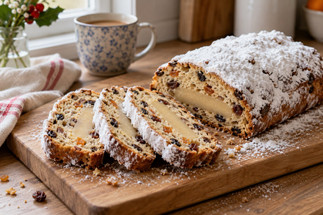
So I put it in a 2lb loaf tin instead. The walls hold everything in while it rises and bakes. It comes out as a neat block that slices like a cake, with a stripe of marzipan in every slice. It isn't the traditional folded shape and I know that, but it tastes the same and the marzipan actually stays where I put it.
Why a loaf tin
A traditional free-form stollen is a flat oval of dough folded over a log of marzipan. Because it bakes on a flat sheet, nothing holds the sides up. As the dough rises and the butter softens, it spreads out, and the first weak spot in the seam lets the marzipan run straight onto the hot tray.
In a loaf tin, the walls hold the roll tight while the dough is soft. The seam sits underneath, so the marzipan has nowhere to go. You also get slices that are all the exact same size. A folded stollen never gives you that, because the ends are always dough and the middle is solid marzipan.
What you lose is the shape. A traditional stollen is meant to look like a baby wrapped in a blanket, and mine looks like a loaf. I just put icing sugar all over it and nobody has complained yet.
The tin
I use a standard 25 x 13 x 8cm 2lb loaf tin. Stollen dough is stiff and packed with fruit, so you want a fixed base, straight sides and heavy steel. Carbon steel heats evenly, so the ends don't go dark while the middle is still raw. That's exactly what happens in thin tins.
Our non-stick loaf tins are made without PTFE or PFOA and come with a 10-year warranty. They wash up with warm water and a sponge. Because butter and sugar are the two things that bake onto a tin, I dry mine straight away, which is most of the care guide.
You don't have to line it, but I do. I'd rather lift a buttery, sugary loaf out by the paper than run a knife round it. How to line a loaf tin shows the fold. Use baking parchment, because greaseproof paper sticks.
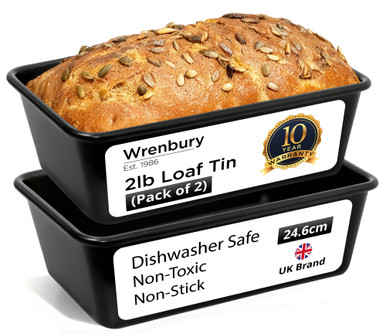
Non Stick 2lb Loaf Tin Pan Set of 2
£26.99 £31.99
Two 25 x 13 x 8cm tins in heavy carbon steel, non-stick made without PTFE or PFOA. One stollen to keep, one to give away.
View product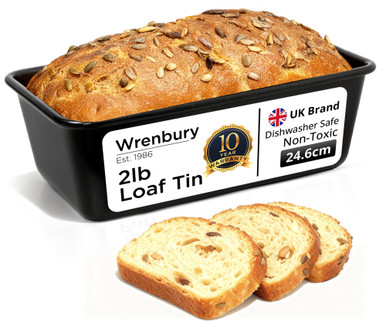
Non Stick 2lb Loaf Tin Pan
£15.99
The single 2lb tin, same steel and the same coating. Ten generous slices from one bake.
View product
Non Stick 1lb and 2lb Loaf Tin Pan Set of 2
£24.99
The 2lb for the family stollen and the 1lb for a small gift loaf from the same dough.
View productThe mix (makes one 2lb stollen)
For the fruit, the night before:
- 150g mixed dried fruit (sultanas, currants and chopped peel)
- 3 tbsp rum, orange juice or strong tea
- 30g flaked almonds
For the dough:
- 250g strong white bread flour
- 7g fast-action yeast
- 40g caster sugar
- ½ tsp fine salt
- 1 tsp mixed spice, ½ tsp ground cardamom (optional) and the zest of an orange
- 1 egg
- 90ml whole milk, warmed
- 75g soft butter
To fill and finish:
- 150g white marzipan
- 50g butter, melted
- Icing sugar
Soak the fruit overnight, because dry fruit steals moisture from the dough while it bakes. I use tea if children are eating it and rum if they aren't.
Strong bread flour gives the chew a stollen should have. Don't expect a big rise either, because a stollen that rises like a brioche has too little fruit in it.
How to bake it
How to bake stollen in a 2lb loaf tin
- Soak the fruit: The night before, put the fruit, the rum or juice and the almonds in a covered bowl and leave it on the side.
- Mix the dough: Mix the flour, yeast, sugar, salt, spices and orange zest in a large bowl. Add the egg and the warm milk and bring it together into a rough dough, then work in the soft butter a bit at a time.
- Knead and rise: Knead for ten minutes by hand, or eight in a mixer. It's a stiff dough and it feels tight, which is right. Cover it and leave it somewhere warm for an hour to an hour and a half, until it has roughly doubled.
- Add the fruit: Squeeze the soaked fruit dry in a sieve and knead it into the dough in two goes. It tears a bit and looks a mess for a minute, and then it comes together.
- Roll round the marzipan: Roll the marzipan into a log about 20cm long. Roll the dough out to roughly 25 x 20cm, lay the log along one long edge, roll the dough up round it and pinch the seam shut along the whole length. Pinch the ends too.
- Line and prove: Line the tin with baking parchment and lay the roll in seam side down. Cover it and leave it for 45 minutes to an hour, until it has come about two-thirds of the way up the tin. Heat the oven to 180°C, or 160°C fan, towards the end.
- Bake: Bake on the middle shelf for 45 to 50 minutes. Lay a piece of foil loosely over the top after 25 minutes, because the sugar in the dough colours quickly in a dark tin.
- Test it: Check it from 45 minutes. A probe in the centre should read 88 to 90°C, or push a skewer in about 3cm from one end where there's no marzipan and it should come out clean. If you go through the middle you'll hit the marzipan and think it's raw.
- Butter and sugar: Leave it in the tin for ten minutes, then lift it out by the paper and brush it all over with the melted butter, top, sides and ends. Sift icing sugar over it while it's still warm, and once it's completely cold give it a second, thicker coat.
The butter is what makes stollen keep. It soaks into the outside and the sugar on top sets into a crust that stops the crumb drying out over the next two weeks. I put the sugar on as thick as I dare and then add a bit more.
When it goes wrong
If the marzipan has leaked or vanished, the seam wasn't sealed along its whole length, or the log was too close to the edge of the dough and there was a thin patch over it. Pinch the seam hard, leave a thumb's width of dough all round the log and bake it seam side down. The marzipan never melts into the dough completely, so a soft stripe in the middle of the slice is normal.
If it's dry, the fruit probably wasn't soaked, or it stayed in the oven too long, or it missed its butter. Take it out at 90°C and no higher, and brush it while it's hot, because a stollen that comes out dry doesn't soften by itself.
If it's heavy and pale underneath, the dough wasn't kneaded for long enough. The fruit and butter make it hard to stretch, so it needs the full ten minutes. Some density is right, though, and a stollen that rises like a brioche has too little fruit in it.
If the top has caught, that's the foil at 25 minutes. When the sides catch as well, drop the oven to 170°C next time and give it five more minutes.
Making it ahead
Like a Christmas cake, stollen is baked weeks before you need it. It comes out firm and a bit plain, and over the next fortnight the butter and sugar and the juice from the fruit work their way through the crumb until it goes soft and smells of Christmas. Wrap it in baking parchment, then foil, and keep it in a tin somewhere cool.
Two weeks is what most bakers recommend, so I'd bake in the first week of December, or the last weekend of November if you want to be well ahead. If you'd rather bake sooner, freeze it wrapped and dust it with fresh icing sugar once it has thawed.
(It's the same waiting game as my air fryer Christmas cake and the parkin in a loaf tin. I bake, I wrap, and then I try very hard to leave it alone.)
Little ones for presents
The same dough makes two small stollen in 1lb tins. Split it in half, roll each piece out smaller, and put a 75g log of marzipan in each. A 1lb loaf tin wraps up nicely in parchment and ribbon. I haven't timed this one carefully, so start checking at 30 minutes and trust the probe. You'll find every size in the loaf tins collection, and best baking gifts UK has more ideas for things to bake for people.
Common questions
Can you bake stollen in a loaf tin?
Yes. Use a 2lb loaf tin, about 250g of flour in the dough and 150g of marzipan rolled into a log down the middle. Bake it at 180°C, or 160°C fan, for 45 to 50 minutes with foil over the top from 25 minutes. The walls keep the roll tight, so the marzipan stays inside.
Why did the marzipan leak out of my stollen?
Either the seam wasn't sealed along its whole length or the marzipan sat too close to the edge of the dough. Pinch the seam shut, leave a thumb's width of dough all round the log, and bake it seam side down in a tin so the walls hold it closed.
Is stollen meant to be dense?
Yes, it's a heavy fruity bread and it doesn't rise like a brioche. It should feel firm and spring back a little when you press it, and it softens as it matures.
How far ahead can I make stollen?
Two weeks is the usual advice, wrapped in parchment and foil and kept in a tin. You can freeze it for up to three months and give it a fresh dusting of icing sugar once it has thawed.
Do I need to line the loaf tin?
The non-stick coating means you don't have to. I line it anyway, because butter and sugar bake onto a tin and the paper lets me lift the stollen out in one piece.
Can I use plain flour instead of bread flour?
You can, but the crumb comes out softer and crumblier. Strong white bread flour gives the chew a stollen should have.
The short version
A 2lb loaf tin, a stiff fruity dough rolled round a log of marzipan, 180°C for 45 to 50 minutes, and plenty of butter and icing sugar the minute it comes out. Make it two weeks before you need it. If you're still choosing a tin, our loaf tin buying guide goes through the range.