
Posted by Mia Wren on 5th Aug 2026
Best Bakeware UK: A Guide to Buying Once
Most people don't buy bakeware once. They buy it three or four times. A cheap tin sticks or warps or loses its coating, so it gets replaced with a slightly less cheap one, which fails a little slower, and so on up the shelf until either the baking stops or the spending does. If you've got a drawer with a warped tray, a loaf tin that grips the corners of every bake, and a muffin tin gone brown at the edges, you already understand the problem this guide is about.
The good news is that the fix is boring and permanent. There is no secret brand, no magic coating, no gadget. There's just heavier metal, a coating that's bonded properly, sizes that fit a UK oven, and a guarantee long enough that the maker has to mean it. Get those four things right and the tin stops being something you think about. It sits in the cupboard, does its job, and is still there in ten years.
This is the long version of that answer. We'll start with why cheap bakeware fails, because once you understand the failure you can spot the difference in a shop without reading a single spec sheet. Then we'll go through what actually matters when you buy: material, weight, coating, size, and the guarantee. After that we'll cover what a home baker genuinely needs, category by category, with the specific buying guides for each. And we'll finish with the honest way to start from scratch without buying a cupboard full of things you'll never use.
Why most cheap bakeware fails early
There's a chain of failure that runs through nearly every tin that ends up in the bin, and it almost always starts the same way.
It begins with thin metal. A tray or tin pressed from 0.3mm steel or thin aluminium doesn't have the mass to heat evenly, so when it hits a hot oven, one part expands faster than another. The stress has to go somewhere, and in thin metal it goes into a buckle. That's the sharp metallic bang you hear a couple of minutes after the oven door shuts. Sometimes the tin settles flat again as it cools. Do it enough times and the warp becomes permanent, and a warped tin never bakes evenly again: batter pools at one end, biscuits come out thick on one side and thin on the other, nothing sits level.
The warping is also what kills the coating. A non-stick surface is bonded to the metal underneath it. Every time the metal flexes, the coating is stretched and stressed at a different rate to the steel it's stuck to. Bonded coatings are hard and brittle, so that repeated flexing works tiny cracks into the surface, usually starting at the corners. Once the coating cracks, food starts to grab, then it visibly wears, then it flakes. On a budget tin the coating was thin to begin with, applied over a plastic primer rather than bonded straight to the metal, and every dishwasher cycle strips a little more of it.
Rust is the last stage. Once the coating has worn through, the bare steel underneath meets water, usually in the dishwasher or left to air-dry in a rack, and brown spots appear. At that point most people bin the tin, which is a reasonable thing to do. But it's worth seeing the whole chain for what it is: the rust was caused by the coating failure, which was caused by the warping, which was caused by thin metal. Fix the metal and the rest of the chain never starts.
This is the single most useful thing to understand before you spend any money. Thin metal is the root cause of nearly every bakeware complaint there is, so the whole job of buying well is really the job of buying heavy. If you want the direct comparison of the two metals at the heart of it, carbon steel vs aluminium bakeware explains why thin aluminium buckles where heavy carbon steel holds.
What separates bakeware worth owning
Knowing how tins fail, the shopping list writes itself. There are only four things that matter, plus one that tells you whether the maker believes in the other four.
Material: why carbon steel
Bakeware is made from a handful of materials, and they are not equal for the job.
Carbon steel is what most professional bakeware is made from, and what we build with. It's dense, so it holds heat and spreads it steadily, which is what gives you an evenly golden base instead of a pale middle and scorched edges. It's rigid, so at a decent thickness it doesn't flex and warp. Its one genuine weakness is that bare carbon steel rusts, which is why it's always either seasoned like a cast-iron pan or given a non-stick coating. A coated carbon steel tin gives you the even bake and the clean release without any of the maintenance.
Aluminium conducts heat quickly and is light, which is why commercial kitchens stack it high. But the aluminium bakeware sold for home kitchens is usually thin, and thin aluminium warps readily. Professional bakers get away with it because their trays are thick, stored flat in stacks, and treated as consumables that get replaced without a second thought when they dent. That's a sensible system for a bakery and an expensive habit for a home.
Stainless steel is durable and has no coating to fail, which sounds ideal until you bake in it. It's a mediocre heat conductor, so thin stainless develops hot spots, and food sticks to it enthusiastically. Most owners end up lining it with parchment for everything, which works but rather defeats the point of buying a good tin.
Glass and ceramic hold heat well but respond slowly, which makes them fine for a casserole or a crumble and poor for anything that needs a crisp base or a fast, even bake. Keep them for the Sunday pudding.
For the full picture of how a coated carbon steel tin compares to the cheap non-stick most people start with, carbon steel vs non-stick bakeware goes through it properly.
Weight and gauge
Thickness of metal, the gauge, is what determines whether a tin heats evenly and holds flat, and it's the one thing you can check with your hands in a shop without any label at all. Pick the tin up. A good one feels substantial and doesn't flex when you hold it by one edge. A tin that bends in your hand will buckle in the oven. Heavier is better, almost without exception, and the weight in your hand is the most honest signal of quality you'll get on a shelf. This is why bakeware you order online should list its gauge or its weight, and why the cheapest tins never do.
The coating, and what it's made from
A coating is only as good as what it's bonded to and how thickly it's applied. A fragile film on thin aluminium fails within months. A quality coating bonded directly to heavy steel, with no plastic primer layer underneath, wears at a completely different rate.
It's also worth knowing what the coating actually is. There has been a lot of consumer worry about non-stick surfaces, most of it aimed at older coatings and the chemicals once used to make them. Every Wrenbury tin except the crumpet rings uses a non-stick coating made without PTFE or PFOA, bonded straight to the carbon steel. The crumpet rings use a different, PFOA-free coating, which we're always specific about because getting a coating claim wrong helps nobody. If you want the plain-English version of what these labels mean and which ones matter, what PTFE-free bakeware actually means is the guide for that.
Whatever you buy, treat "dishwasher safe" as "dishwasher tolerant". Any honest maker, us included, will tell you that hand washing keeps a coating in better shape for far longer. The dishwasher won't destroy a good coating in one go, but every cycle costs it a little.
Size that fits a UK oven
This is the detail that catches people out, especially when buying online from listings written for other markets. A standard UK built-in oven is 60cm wide on the outside, which leaves an internal cavity of around 45 to 48cm. For an even bake you also want 2 to 3cm of air moving around whatever you've put in, so the practical maximum for a flat tray is about 40cm long. Plenty of imported "half-sheet" pans are sized for wider American ovens and simply won't fit, or will fit so snugly that the airflow that bakes evenly is gone. Measure your oven's internal shelf before buying anything large.
The guarantee, and why it's the real tell
A guarantee is a maker's own prediction of when its product will fail. A tin guaranteed for a year is a tin the maker expects to fail not long after one. Every Wrenbury product carries a 10-year guarantee that covers warping, coating defects, peeling and flaking in normal use. That isn't a marketing flourish stuck on at the end. It's a direct consequence of the steel thickness, because you cannot guarantee thin metal for a decade. It won't survive one. When you're comparing two tins and can't feel the gauge through the packaging, the length of the guarantee tells you what the maker knows about the metal.
What a home baker actually needs
Here's the part where most "essential bakeware" lists go wrong: they list everything, because a longer list looks more thorough. In reality, what you need depends entirely on what you bake, and a smaller number of good tins beats a cupboard of things bought for one recipe and never used again. Work through these categories honestly and buy the ones that match your baking.
Loaf tins
If you bake bread, banana bread, tea loaves or a Madeira, a loaf tin is the piece you'll use most. The two sizes that cover nearly everything are the 2lb, which is the standard for a full loaf of bread or a large cake, and the 1lb, which suits smaller tea breads and happens to fit inside most air fryers. A good loaf tin releases cleanly from the corners, which is exactly where cheap tins grip. Our full breakdown of sizes, materials and the traps to avoid is in the best loaf tin UK buying guide, and the whole loaf tin range sits alongside it.
Baking trays
Two flat trays do more work than anything else in the kitchen, because ovens have two shelves and biscuits are always baked in batches: one tray loads while the other bakes. A quarter-sheet tray around 33 × 23cm is the everyday size that fits any oven with airflow to spare, and a larger tray around 39 × 27cm handles Swiss rolls, focaccia, roasting and family traybakes. Both should be heavy enough to stay flat. We've covered materials, sizes and the failure modes to avoid in the best baking trays UK guide, and the baking tray range has the sizes that fit UK ovens.
Muffin and cupcake tins
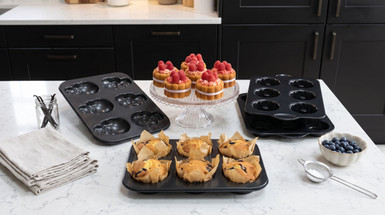
A 12-cup muffin tray is the one most kitchens want, useful for muffins, cupcakes, Yorkshire puddings at a push, egg bites and individual traybakes. If you bake in bigger batches, a 24-cup mini tray earns its place, and a 6-cup jumbo tray gives you bakery-sized muffins with a proper dome. The thing that separates a good muffin tray from a bad one is even heating across all twelve cups, so you don't get six golden ones at the front and six pale ones at the back. The best muffin tin UK guide runs through the choice, and the muffin and cupcake range has the full set.
Yorkshire pudding tins
If a proper Sunday roast is part of your week, a Yorkshire pudding tin is worth owning as its own thing rather than making do with a muffin tray. The cups are shallower on purpose, which is what gives you a crisp, risen pudding with a natural well for gravy instead of the dense, gummy result a deep muffin cup produces. We go into shape, depth and why cheap trays give flat puddings in the best Yorkshire pudding tin UK guide, and the Yorkshire pudding range is there when you need it.
Speciality tins
Beyond the everyday pieces, speciality tins are entirely about what you actually bake. Crumpet rings, mini cheesecake pans, fluted cake tins, donut pans, mince pie tins: each is worth having only if you make the thing it's for. There's no point owning a mince pie tin you use once a year if you'd rather buy the mince pies, and every point in owning one if December is your baking season. Buy these to match your baking, not to complete a set.
The honest way to start from scratch
If you're setting up a kitchen from nothing, or clearing out everything that's warped and starting again, the sensible approach is to cover the bakes you make most often in one go and add speciality tins later as you need them.
That's the thinking behind our five-piece starter set. It's the set most people would build for themselves if they knew which pieces to buy.
Those five pieces cover bread, muffins and cupcakes, Swiss rolls and traybakes, cookies and sheet-pan meals, and the air-fryer loaves that have become the everyday bake for a lot of kitchens. It's the same heavy carbon steel and the same coating as the individual tins, and the same 10-year guarantee covers all five. If you'd rather build up gradually, or want a set aimed at a particular kind of baking, the baking bundles group the tins in a few different combinations.
Whichever way you go, the principle is the same one this whole guide comes down to: buy the pieces you'll actually use, buy them heavy, and buy them once.
Make it last
Even the best tin fails early if it's treated badly, and three habits do most of the damage. Running a hot tin under the cold tap is thermal shock, the same sudden stress that warps thin metal, and it will eventually warp good metal too. Leaving a tin to soak overnight lets water sit against the steel, which is how rust starts. Stacking tins away wet does the same thing in the cupboard. The fix is a minute of effort: wash by hand in warm soapy water, dry with a tea towel straight away, and store dry. Done consistently, that routine will see a good tin past its guarantee. The full version is in our care and use guide, and the longer read is how to make your baking tray last 10 years.
One thing you don't need to do is season a coated tin. A non-stick carbon steel tin is ready to bake with out of the box, and oiling and heating it to "season" it just builds a gummy film that's a nuisance to remove. We've covered when a new tin needs seasoning and when it doesn't in do you need to season your new baking tin.
Frequently asked questions
Is expensive bakeware actually worth it, or is it just a brand markup?
It depends entirely on where the money goes. Paying more for thicker metal, a coating bonded straight to the steel, and a long guarantee is worth it, because those are the things that stop a tin warping, sticking and rusting. Paying more for a name with the same thin metal underneath is not. The test isn't the price, it's the weight in your hand and the length of the guarantee. A heavier tin with a 10-year guarantee that you buy once is cheaper over a decade than three cheap tins bought in a row.
What bakeware material is best for home baking?
Coated carbon steel suits home baking better than the alternatives for most people. It's dense, so it spreads heat evenly for a golden, even bake, and rigid, so at a proper thickness it doesn't warp. The coating gives clean release without the maintenance bare steel needs. Aluminium is light and warps easily at home-kitchen thicknesses, stainless steel conducts heat poorly and sticks, and glass or ceramic bake slowly and won't crisp a base.
How much bakeware do I actually need to start?
Less than most lists suggest. For most home bakers, two flat trays, a 12-cup muffin tray and a loaf tin cover the majority of everyday baking, with speciality tins added only for what you actually make. A five-piece set covering bread, muffins, Swiss rolls, cookies and air-fryer loaves is a complete starting point, and you can add a Yorkshire pudding tin, crumpet rings or a cheesecake pan later as your baking calls for them.
Why does my bakeware warp, stick and rust, and how do I stop it?
All three usually come from the same root cause: thin metal. Thin metal warps in the oven, the warping cracks the bonded coating so food starts to stick, and once the coating flakes the bare steel underneath rusts. Buying heavy-gauge carbon steel stops the chain at the start. Then avoid thermal shock (no cold water on a hot tin), hand wash rather than using the dishwasher, and dry the tin straight away rather than letting it sit wet.
What does the 10-year guarantee actually cover?
Wrenbury's 10-year guarantee covers structural failure and coating degradation in normal use: warping, peeling, flaking and coating defects. It exists because the tins are made from heavy-gauge carbon steel that isn't expected to fail in that time, which is the whole point of a long guarantee. A maker can only offer a decade of cover on metal thick enough to survive it.
Can I put good bakeware in the dishwasher?
Wrenbury tins are dishwasher safe and the occasional cycle won't ruin them, but hand washing keeps any coating in better condition for far longer. Dishwasher detergent is designed to strip baked-on grease and doesn't distinguish between that and the surface of your tin, so every cycle costs the coating a little of its life. A minute in warm soapy water and a quick dry with a tea towel is the routine that gets a tin past its guarantee.
The short answer
Good bakeware isn't a brand, it's a set of properties: heavy-gauge carbon steel, a coating bonded straight to the metal and made without PTFE or PFOA, sizes that fit a UK oven, and a guarantee long enough to mean something. Buy the pieces you'll genuinely use, whether that's a full starter set or a loaf tin and two trays, and buy them once. The best bakeware is the kind you stop thinking about: it sits in the cupboard, bakes evenly, releases cleanly, and is still doing both in ten years.